Business Rules Management System
– or in short is called “BRMS”.

- What is a Business Rules Management System (BRMS)?
- Key Components of a Business Rules Management System – BRMS
- Benefits of Using a Business Rules Management System
- Business of Rules Management Lifecycle
- Business Rules Management System Use Cases
- Lacking Capabilities in Business Rules Management System
- Choosing the Right Business Rules Management System
- Integrating a BRMS with Decision Intelligence
- Conclusion
What is a Business Rules Management System (BRMS)?
A Business Rules Management System (BRMS) is a software solution that enables organizations to define, deploy, monitor, and manage complex business rules independently of application code or embedding into process models.
Business rules are specific, conditional statements that guide decisions and processes—essentially framing how an organization operates based on varieties of business rules such as policies, regulations, corporate strategy and procedures and so on.
For instance, below are some examples of applying business rules:
- eligibility requirements for offering a financial product
- pricing strategy based on personal and individual needs
- guidelines on approval or refusal in workflows
- regulatory compliance mandates in banking, health and other regulated industries
The Business Rules Management System (BRMS) aims to create a repository of business rules across organizations and establishes the single source of through for business rules.
By establishing a centralized repository of business rules in a BRMS, organizations can maintain consistency across their business operations, quickly adapt to changing policies, and reduce the risk of human error.
Key Components of a Business Rules Management System – BRMS
In any BRMS there are several key components that need to work together seamlessly. These components enable end-user to create, update, test, deploy business rules in a centralized repository. They also enable organizations to implement change management processes and integrate BRMS into their own workflow.

Rule Repository
A centralized database where all business rules are stored. This repository serves as a single source of truth, ensuring that rules are consistent and up to date across all applications and departments. The repository should provide various options for business rules versioning and control.

Rule Engine
The core processing component of a BRMS is the rule engine. It applies business rules based on input data to create outcomes in real time or batch. This engine enables automated decision-making for rule-driven business decisions therefore, it will reduce the need for manual intervention, referral in workflow and so on.

Authoring Environment
Arguably this is one of the most important components of the BRMS as it will enable not only technical teams (e.g. Software development) maintain the rules outside of systems and processes but also, it will enable business and operation team to create, modify, and manage business rules with very less reliance on IT.

Testing (Quality Assurance) and Simulation
Testing tools allow users to run simulations on new rules to ensure they work as intended without disrupting existing operations. This reduces the risk associated with deploying new rules in a live environment. But also, it will enable users to step through the rules execution and inspect values and rules in real-time in action.

Monitoring and Reporting
BRMS platforms often include tools for tracking rule performance, identifying bottlenecks, and generating reports on rule usage, effectiveness, and compliance. This component of BRMS enables tracking and logging and tracing rules execution in production and understanding the outcome associated with specific business rules.
Benefits of Using a Business Rules Management System
Implementing a BRMS across organization is not a trivial task, however it offers enormous advantages that drive efficiency, accuracy, and agility across the enterprise organization:
- Consistency: Hence business rules are centralized, and the business rule engine (BRE) is responsible for executing them against the input data, organizations can achieve consistency across rules execution and therefore, consistent outcomes for rule-driven business decisions.
- Compliance: By centralizing business rules, a BRMS ensures that the same rules are applied across departments and applications. Enforcing the business rules related to regulations and laws in applications and processes will improve compliance with industry regulatory bodies and company policies.
- Enhanced Agility: Organizations can quickly adapt to changing policies, regulation or market conditions by updating business rules in the centralized repository of the BRMS without needing to modify application code or business process model. This brings agility to enterprise organizations where operating in a regulated environment such as banking, financial services, health, government agencies, insurance and so on.
- Minimizing errors: Managing business rules and automating the rules execution by a BRMS will reduce the manual effort required to apply rules, which as a result, will reduce errors when it is done by human on a manual basis.
- Empowerment of Business Users: Modern BRMS platforms often provide intuitive user interfaces that enable non-technical users to manage rules. Enabling business rules to be managed outside IT with software development team brings significant benefit to both IT and business as a whole. Business and operation teams can create, modify, test, deploy business rules and let IT focus on more strategic priorities.
Business of Rules Management Lifecycle
Business rules are all over the business operation. Specially in the regulated or dynamic business. The rules should be managed within the context of operation and that's what defines the rules management lifecycle.
At a very high-level the process of rules management looks like below:
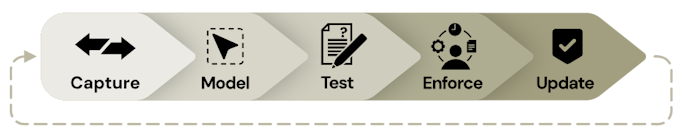
- Capture: At this stage, business rules must be captured from various sources such as processes and applications. Many of the business rules may not be in operation or they may be in the heads of people doing the actual job.
- Model: At this stage of process, we will create details view of the business rules that allows execution at runtime which various rules modeling techniques
- Test: This stage of process allows testing the modeled business rules based on some inputs. This can be done in isolation, as part of specific decision-making scenario either in manual or automated approach.
- Enforce: this stage of process will integrate business rules in application and processes ensuring they are applied in decision-making scenarios.
- Update: at this stage of process, we can look at the changes that might be needed based on the outcome of execution, or sources of change (regulation, external or internal events) and update the business rules in the centralized repository. Which is essentially repeating this process.
When a change happens either based on regulation, policies or status of a case the business rules will require an update. In these cases those changes will trigger the change management process which starts from capturing the business rules and carries on until the change is deployed and enforced.

Business Rules Management System Use Cases
Across all different sets of industries and segments, BRMS will be integrating business rules into organizations processes. This can be within IT systems, off-the-shelf enterprise solutions such as ERP, CRM, Loan origination solutions etc. as well as Business process management (BPMS) that automates workflows and processes.
Straight-through processing is the technique that can be applied in all processes, it essentially allows you to encapsulate the logic behind decisions and capture them informs of business rules (when applicable). Then before the gateway in you business process, the set of rules will be executed to create outcome and will pass the results of execution to application or process context.
The outcome of applying straight-through processing is streamlining business operation. A BRMS can be applied across various industries to streamline business processes by automating the rule-driven business decisions behind the decision point.
- Banking and Financial Services: Automate credit scoring, loan approvals, and fraud detection processes by applying rules based on financial data, credit history, and transaction patterns.
- Insurance: Standardize underwriting rules, determine premium calculations, and handle claims processing efficiently, reducing manual effort and increasing accuracy.
- Healthcare: Ensure compliance with treatment guidelines, automate patient eligibility checks, and support billing and claims management processes.
- Retail and E-commerce: Personalize promotions, manage product pricing dynamically, and enforce return policies consistently across channels.
- Government and Public Sector: Streamline eligibility checks for public benefits programs, improve compliance, and automate regulatory reporting.
Explore Your Industry Use Cases




Lacking Capabilities in Business Rules Management System
While Business Rules Management Systems (BRMS) and focus on automating rule-driven decision-making makes organizations somewhat agile, there are key challenges in adapting them at an enterprise-wide scale that will not allow them to truly deliver “decision agility” in a relatively fast pace and dynamic environment.
- Standardization: standardization of business rules is one of they key driver of adapting BRMS. However, the rule-driven approach lacks compliance with any open, and vendor-neutral standard such as Decision Model and Notation (DMN). This lack of standardized notation and language make organizations locked-in to vendors approach and their proprietary language which in long term it is an operational debt and risk.
- Focus: BRMS is rule-driven, focusing on the execution of predefined rules. They often lack incorporating data analytics, machine learning, and other techniques to make and execute more complex business decisions.
- Complexity: BRMS uses a bottom-up approach (i.e. rule-driven approach) and therefore, users focus very early on details of rules modeling which makes it difficult for many operation and business users. They manage and store rules and this causes the problem that is called the “big bucket of rules problem”.
- Context: The issue with starting with business rules is that they are too granular therefore they do not have context. This makes it very hard to write effective rules without knowing the why behind them. Missing the context on managing rules (create, update, improve etc.) makes it very difficult to understand the impact, relation and dependencies in the broader picture.
- Reusability: Business rules are too granular and have no context, therefore it is very hard to make rules reusable. Reusability requires context and cohesiveness which they both lack in business rules approach. Sharing and reusing rules makes improving decisioning scenario and changes to individual rules almost impossible as it introduces lots of risks around consistency and quality of the outcomes.
- Data and Services Integration: BRMS solutions are not big in data and services integration. Generally, you (as the consumer) need to prepare everything upfront and send it to the engine or service for processing. This is a very sub optimal solution that requires code or process model changes, IT involvement, system deployment which contradicts the very big benefits of using BRMS in the first place.
- Orchestration: orchestration is a big requirement in enterprise implementation of any BRMS. It allows to integrate systems, data, services and coordinate between them based on different circumstances in different scenarios. BRMS do not provide any orchestration capability out of the box and requires coding, or other 3rd party platform integration.
Choosing the Right Business Rules Management System
When selecting a BRMS, there are several factors need attention:
- Modeling standardization: Make sure vendor has Decision Model and Notation – DMN with Conformance Level 3 for modeling and executing business rules.
- Ease of Use: Look for platforms that offer intuitive rule-authoring tools and interfaces that are similar to tooling non-technical people use every day such as Excel, Visio and so on. These UI similarities reduce the learning curve. Conformance Level 3 with DMN makes sure the rules language is based on FEEL (Friendly Enough Expression Language) which is designed for non-technical people to express complex rules logic.
- Debugging: Modeling a rule is one thing, but debugging the scenario, stepping though each rules in live and inspecting context of execution and understanding how they behave is different. Live debugging and stepping through capability with breakpoints are essential part of business rules management lifecycle that cannot be missed.
- Scalability: Scalability in BRMS has two perspectives. At runtime, the execution of rules can scale meaning they can support more throughputs. At modeling and development time it means more people can get onboard, understand and start modeling rules which is mostly related to DMN techniques of rules modeling. So make sure the vendor has DMN CL3 offering.
- Integration: Choose a BRMS that integrates seamlessly with your existing software and databases to ensure smooth data flow. The integration with applications can be In-Proc or Service based. The in-proc allows you to host the rule engine inside your own application such as JavaScript or .Net engine.
- Deployments: Deployments of models for execution in a batch or processing requests on-the-fly either on prem or in the cloud is always a big challenge. Your organizations may need automated deployment part of a change process using CICD. Or need a simple and single-click-deployment from UI. Depends on your team capacity, and skills.
- Vendor Support: Implementing BRMS in your organizations need ongoing support from the vendor mostly for how-to questions. Make sure they have online documentation that provides updated tutorials, instructions, guides, API on how to get things done.
Integrating a BRMS with Decision Intelligence
A Business Rules Management System is an essential component of a comprehensive solution such as Open Decision Intelligence Platform (DIP). By combining a BRMS with data and analytics, AI capabilities, organizations can automate and augment business decisions in real-time.
Understanding the requirements of a good Business Rules Management System will enable you to also choose the right Open Decision Intelligence Platform as they must provide advance business rules capability in all areas we touch in this article.
Book a Custom Demo
Conclusion
A Business Rules Management System (BRMS) is a powerful tool that centralizes, automates, and streamlines rule-based decision-making across an organization.
BRMS is an essential tool especially in companies that they are regulated or very rule-driven such as banking, financial services, insurance, health, government and many other smaller and larger segments of market.
By implementing a BRMS, companies can ensure consistency, increase agility, reduce costs, and empower non-technical users such as business, operation and SME teams to manage rules effectively. To achieve that, the Decision Model and Notation (DMN) with Conformance Level 3 (CL3) plays a critical role to ensure non-technical team can express simple to complex business rules without having the programming knowledge and coding background.
In a regulated and competitive landscape, a BRMS provides the essential role for operational efficiency and compliance, helping organizations stay agile and responsive.
Composite AI model for
Decision Intelligence