This release makes managing and controlling AI and Agentic systems real through end-to-end Decision Governance.
Today we are releasing FlexRule Open v11.1, a major milestone for our Open Decision Intelligence Platform.
Enterprises already govern data, models, and access boundaries, but the decision itself often remains unmanaged. Open v11.1 changes that by making decisions explicit, executable, reusable, and governable across the full decision lifecycle.
Decision Studio
Web-based decision modeling and execution that carries decisions from model to action, without reinterpretation.
- Models decisions using Decision Model and Notation DMN with Conformance Level 3: Decisions Requirement Diagram (DRD), All available Boxed Expressions, Decision Table and Full support for FEEL
- Other forms of logic documents for rules modeling: Dynamic Decision Graph, Natural Language, Business glossary (terms and Formulas)
- Semantic modeling (Fact Concept)
- Directly executable without gaps between what was modeled and what runs
- End-to-end process orchestration connects decisions to operations
Decision Studio is developed to ensure there is a total backward compatibility with your existing project in Designer. So you can simply load the project and start working with them. Additionally, the user interface is designed to ensure you require very minimum learning based on your experience with our existing authoring environment (FlexRule Designer).
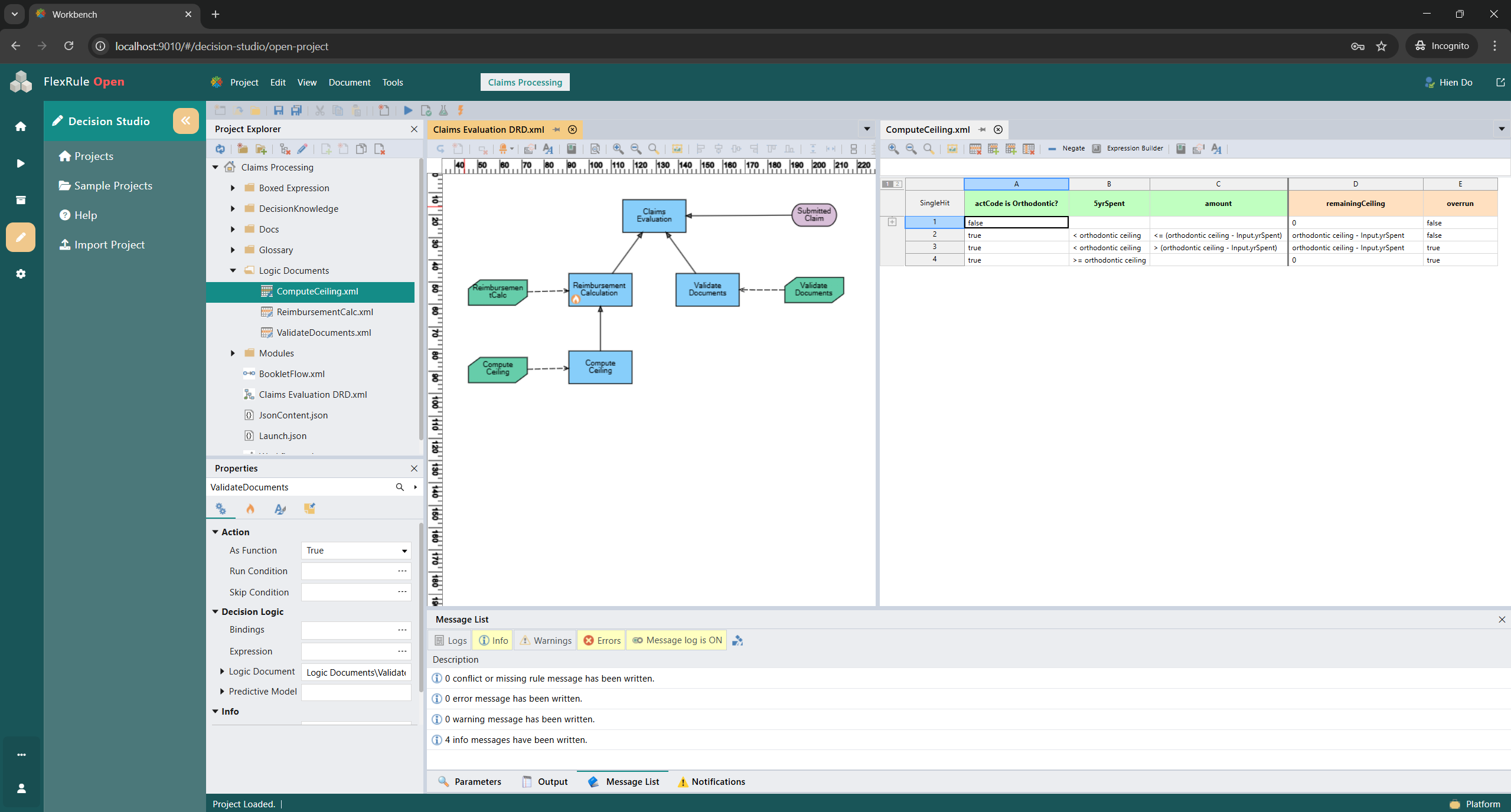
Decision Studio showing a Decision Requirements Diagram and Decision Table based on DMN as a web-based UI. Decision Studio can work integrated into Workbench or standalone web-based UI.
Decision governance requires that what is approved at design time is exactly what executes at runtime. Decision Studio closes that gap by making the decision model the single source of truth across both modeling and execution using a web-based user interface.
LiveContext
A dynamic executable module that gives decisions the governed, queryable context they need to operate consistently.
- Connects to multiple data sources and assembles contextualized knowledge across the decision cycle
- Drives execution for logic generation, model training, and optimization planning
- Eliminates the need to rebuild context for each use case by making it reusable and governed
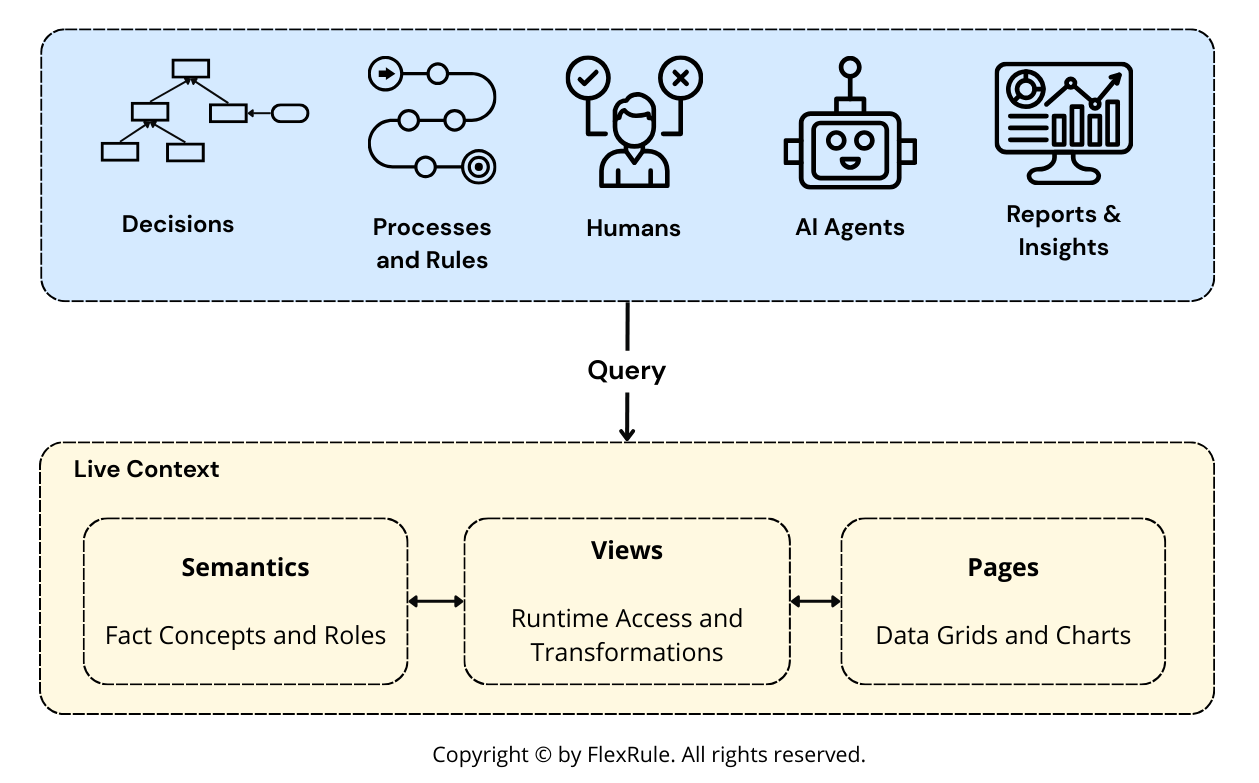
A decision is only as trustworthy as the context it operates on. LiveContext ensures that context is governed, consistent, and auditable across every decision and orchestration, which is foundational to meaningful governance.
Decision Asset Management
Decision Asset Management is the governance layer around the decision model as a whole. It provides a controlled way to manage the assets that make up enterprise decisions, including rules, models, computation, orchestration, context, files, and related objects, so they can be versioned, reused, deployed, and evolved with visibility and discipline rather than being scattered across systems and projects. Unlike traditional repositories suck as GIT, File-based systems etc., Decision Asset Management works across design and runtime stages.
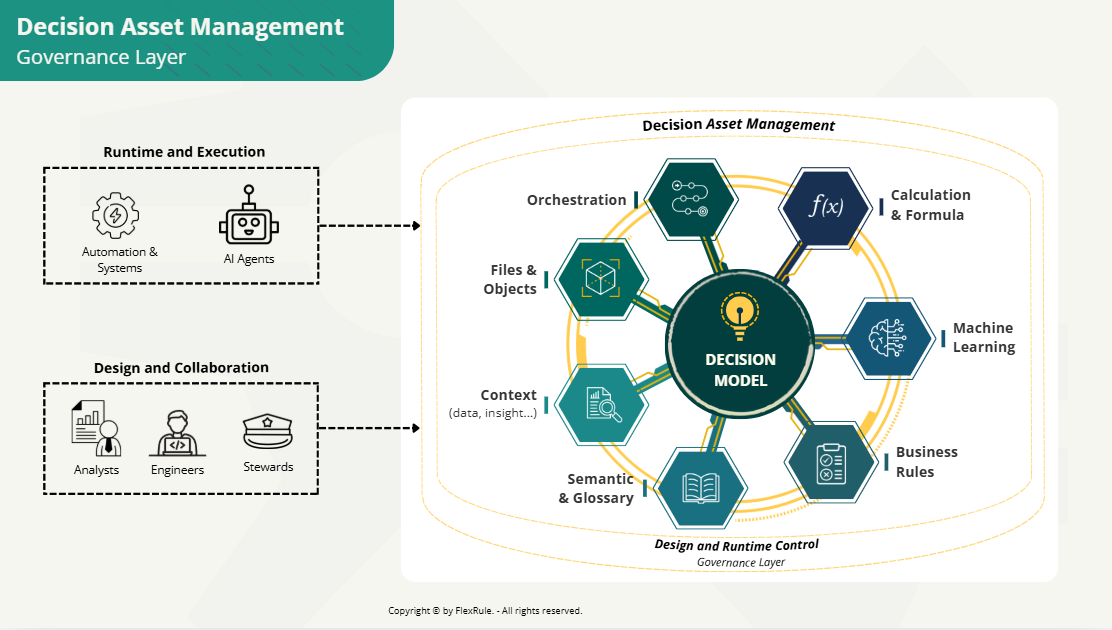
Governed, reusable decisions managed as enterprise assets across projects and teams.
- Bridges design-time collaboration all the way through to runtime execution, unlike repositories that stop at design
- Turns reuse from a code-level concern into a decision-level capability
- Reduces duplication and ensures consistent application of governed decisions across the organization
- Enabling team collaboration within an authorized and controlled boundaries for design and development time
- Govern and control runtime objects and decision modules at runtime across systems, automated processes, AI agents.
Governance breaks down when the same decision is redefined differently across teams and systems. Decision Asset Management makes governed reuse a first-class capability, so the right decision is applied consistently and traceably wherever it is needed.
Activation and Lifecycle Support
Decision governance that extends beyond design-time approval into full operational control.
- Covers signal activation, trigger execution, oversight, and role-based controlled evolution in multi-actor environments
- Supports human-in-the-loop oversight alongside people, systems, bots, and AI agents
- Keeps execution visible, controlled, and aligned so organizations can automate at scale while retaining meaningful control
Governing a decision once at design time is not enough when decisions operate in changing conditions and evolving environments. Lifecycle support ensures that governance travels with the decision through activation, execution, and change, maintaining accountability at every stage.
As AI takes on more decisions across the enterprise, governing the AI model alone is no longer enough. You need to govern the decision itself, the context it operates on, the logic it follows, and the outcomes it produces. That is what Open v11.1 is built for.
If you would like to test our FlexRule Open v11.1 send us an email to info@flexrule.com, or book a demo by filling out the form below.
Book a Custom Demo
Last updated August 12th, 2026 at 11:21 am Published April 17th, 2026 at 02:50 pm