Most AI systems cannot explain a specific past decision. They can describe how the model behaves across a population. They cannot tell you why this decision was made for this person, at this moment. Adaptive Decision Optimization can. Same context, same model, same decision. Always explainable. Always auditable. That is what deterministic AI looks like in practice.
The Problem With AI That Cannot Explain Itself
Most AI systems in production today share a common property: given the same input twice, they may produce a different output. Predictive ML models are probabilistic. Generative AI is stochastic. Both are black boxes. You can measure their aggregate behavior statistically, but you cannot reproduce a specific past decision, explain exactly why it was made, or prove to a regulator that the model behaved consistently. This is the gap deterministic AI closes.
It is worth addressing the chain of thought directly. LLMs can be prompted to show their reasoning steps, and those steps can look like an explanation. They are not. Chain of thought is generated after the output is determined. It does not reflect the actual computation that produced the answer. The reasoning shown is a plausible narrative, not a causal account. It cannot be audited, reproduced, or held accountable. A regulator cannot verify it. A domain expert cannot challenge it. It is text that describes a decision, not the basis on which the decision was actually made.
Adaptive Decision Optimization (ADO) is deterministic AI in practice. Same context, same model, same decision. Every time.
Deterministic AI in Action: A Real Example
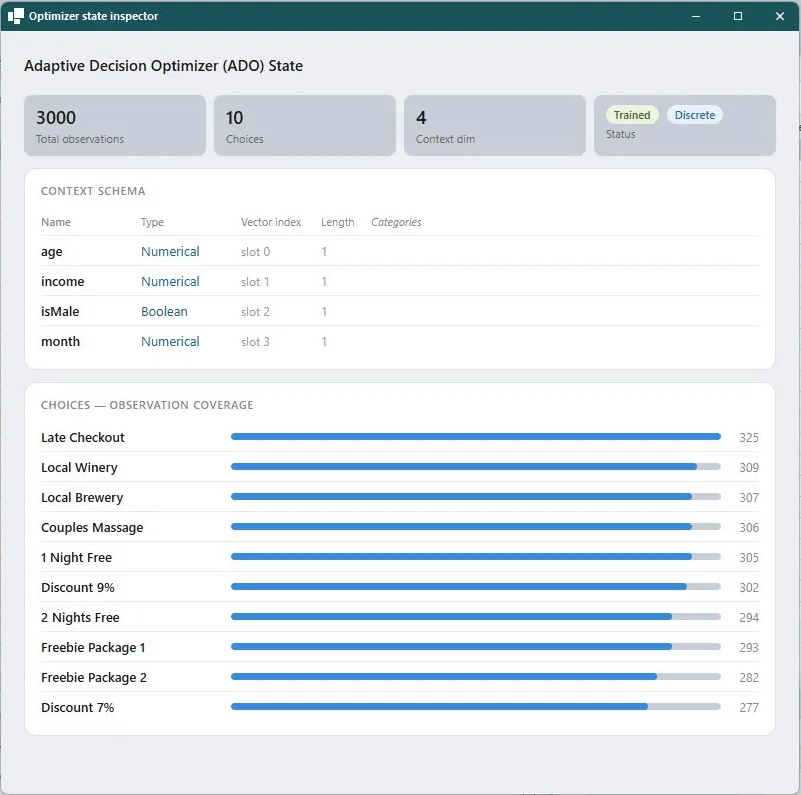
A hotel runs ten offers. Late Checkout, Couples Massage, Local Winery, Local Brewery, two discount tiers, free night packages. The model holds 3,000 observations. Context at decision time: age, income, gender, and month of visit.
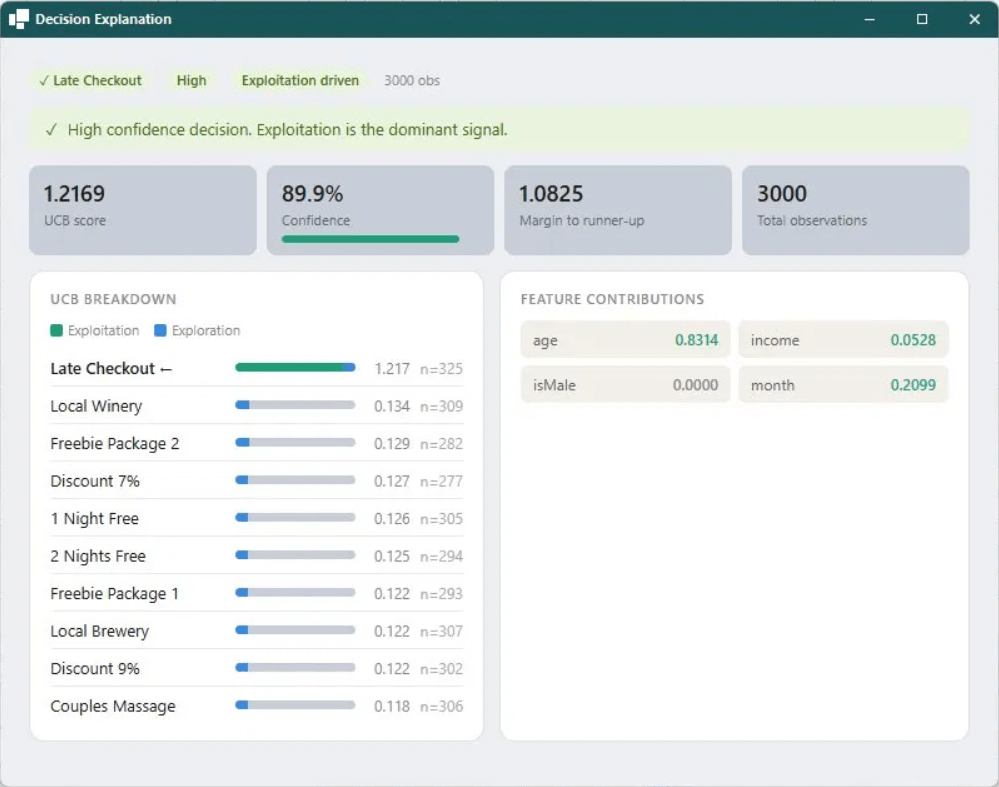
For a specific guest, ADO selects the Late Checkout option. The explanation is not a probability score:
Late Checkout was selected because age contributed 0.83 to the score, month contributed 0.21, income contributed 0.05, and gender contributed zero. 325 observations back this decision. Exploitation ratio 0.89, driven by learned knowledge, not uncertainty.
That zero on gender is worth holding. The model was given gender as a feature. It evaluated 3,000 real outcomes and learned that gender has no bearing on Late Checkout preference for this profile. Not a rule someone wrote. Something the model learned from what actually happened. Visible, questionable, and validatable by any person who looks at it.
The hotel scenario is deliberately simple. Whether or not guests use the Late Checkout offer affects revenue at the margin. But the same capability applies to a different kind of decision entirely.
Discrete Choices and Continuous Ranges
Some decisions are a choice between named options: which offer, which pathway, which intervention. Others require finding the right value within a range: what interest rate, what repayment amount, what discount level. ADO handles both. In either case, the decision is deterministic, explainable, and grounded in what real outcomes have taught the model. The complexity of the problem does not change that.
When the Stakes Are Different
This is where deterministic AI is not a technical preference. It is an operational requirement.
Which hardship pathway should a bank offer a customer who cannot meet their mortgage repayment this month? Which collections approach fits a customer showing early signs of financial vulnerability? Which clinical intervention should be prioritized for a patient whose condition is deteriorating? What repayment value inside the compliant range produces the best outcome for this specific customer in this specific situation?
These decisions carry regulatory obligations. They affect people's financial stability, health, and quality of life. And when something goes wrong, the question a regulator, an auditor, or a court will ask is not statistical. It is specific: why was this decision made for this person, at this moment, given what the organization knew?
A probability score cannot answer that. “The model assigned 73% confidence” describes aggregate model behavior across a population. It says nothing about this decision.
ADO answers the specific question:
Local Brewery was selected because age contributed 0.91, returning customer status contributed 0.07, 500 observations backed this decision, and the exploitation ratio was 0.87, meaning the model was acting on learned knowledge, not exploring uncertainty.
A compliance officer can read that. A domain expert can say yes, that is consistent with what we know about this customer profile, or no, something is wrong here. That is governance. That is what no ML model and no LLM can produce.
Uncertainty vs Hallucination
Probabilistic systems, whether predictive ML or generative AI, absorb uncertainty into their output. They produce a result and move on. The uncertainty disappears into a confidence score, a probability, or a fluent sentence.
They cannot know it is uncertain, and they will not tell you. They cannot tell you which part of the output is made up or which part is based on evidence.
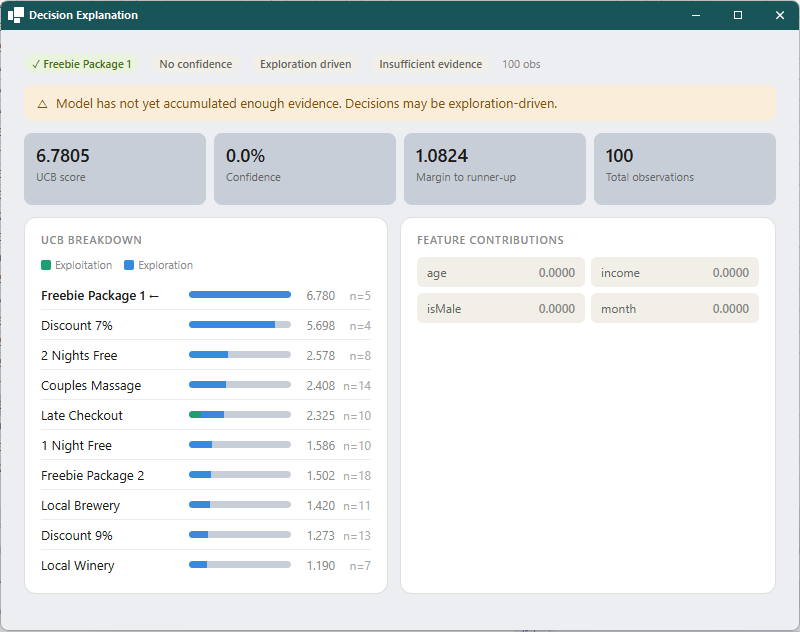
ADO surfaces uncertainty explicitly. The screenshot above shows ADO at 100 observations. Confidence 0.0%. Feature contributions are all zero. The panel states it directly: the model has not yet accumulated enough evidence. It is not absorbing uncertainty into a plausible-looking output. It is naming it.
Run the same context through the same model at any point in time, and you get the same decision. Computed, not sampled. Every past decision is reproducible and verifiable. Every decision is traceable to the exact reasoning that produced it: weights, contributions, confidence, observation count, all recorded and tied to the outcome.
Probabilistic systems hallucinate because uncertainty and knowledge look identical in their output. In ADO, they never do.
ADO always knows what it does not know, and ADO always tells you.
Not Everything Is Knowable Upfront
No decision model can anticipate every situation in advance. New behaviors emerge. Conditions shift. Edge cases appear for which no rule was written to handle.
ADO can operate in this reality because it understands the correlation between input, evidence, and outcome. It knows whether a decision is grounded in learned knowledge or is a random choice into unknown territory. That distinction is explicit at every decision point.
Organizations can configure how much uncertainty is acceptable based on their risk appetite. A function that needs high confidence before acting stays in exploitation. A new area with little history can be set to deliberately explore, accepting uncertain decisions in order to accumulate evidence. The exploratory decisions go out, feedback comes back, and uncertainty turns into evidence. What was unknown becomes known.
ADO does not eliminate uncertainty. It accounts for it, governs it, and learns from it.
How ADO Learns From the Environment
ADO supports three feedback modes. Live feedback means the outcome arrives immediately and the model updates in real time. Batch feedback suits environments where outcomes materialize on a schedule. Offline pipeline feedback handles cases where historical outcome data already exists and is used to train or retrain the model outside live operations.
All three modes produce the same result: a model whose weights reflect real outcomes, updated through a governed process, with the same deterministic and explainable behavior at decision time, regardless of how the feedback arrived. The learning mechanism adapts to what the operational environment allows. The decision behavior does not change.
Governed, Connected, and Situation-Aware
What makes ADO particularly powerful is not the optimizer in isolation. It is where the optimizer sits and what surrounds it.
ADO operates inside an explicit decision model. Business rules define what is possible before ADO is ever invoked. Policies and regulatory constraints determine which options are admissible for a given situation. ADO does not choose from an unconstrained universe. It optimizes within a governed boundary that the organization has defined and owns. The rules establish what can be offered. ADO determines what should be offered, given everything the model has learned about what actually works.
That decision model does not operate as a standalone unit. It is integrated into a decision continuum that is aware of what came before and what comes after. The continuum carries decision memory: what was decided for this customer at prior touchpoints, what stage of the journey they are currently in, and what downstream decisions this choice will influence. ADO does not see a decontextualized snapshot. It sees a situated moment inside a connected sequence of decisions, with the history and the trajectory both visible.
The continuum also closes the loop. Outcomes and their impacts feed back into the system through defined metrics. A decision made three weeks ago produced a result. That result is now part of what ADO learns from. The feedback is not incidental. It is structured, governed, and tied to the measures the organization cares about: resolution rates, customer outcomes, regulatory compliance, and financial impact. ADO learns from the environment it is actually operating in, not from a static training dataset assembled before deployment.
The combination is what separates ADO from any standalone optimizer. Governed by rules. Connected across the decision journey. Aware of context and history. Learning from real outcomes through a closed loop. Every decision is traceable, every adaptation, grounded in what the environment has actually taught the model.
Book a Custom Demo
The Only Optimizer That Is Adaptive, Explainable, and Auditable
ADO is deterministic AI. It is adaptive, supports linear and non-linear, and is built for decisions that carry real consequences. It supports discrete choice and continuous range optimization inside the same framework. It is the only optimizer that is simultaneously adaptive, explainable, and auditable.
The difference between LLMs, Genevieve AI and black box machine learning with Adaptive Decision Optimization (ADO) is accountability. Optimization finds the best answer given what the model knows. Decision-making requires that you can stand behind the answer, explain it to someone affected by it, and demonstrate it was made consistently within the boundaries the organization and its regulators have set.
ADO is deterministic AI built for decision governance in mind.
Last updated June 5th, 2026 at 01:39 pm Published June 4th, 2026 at 11:30 am