For decades, many different disciplines and technologies have tried to improve human judgment and decision-making. However, to this point, neither technology nor humans seem to be getting better at it.
The problem with judgment and decisions
1. Problem with Data
It all started with the belief that “data” would help organizations make better decisions. However, research shows people do not often rely on data when making decisions. Most of them use data to justify decisions they have already made rather than use data to make and execute decisions.
On average, between 60% and 73% of all data within an enterprise goes unused for analytics.
– Forrester
2. Problem with Noise
Humans are very bad at making judgments and, therefore, decision-making. They are constantly influenced by factors such as biases, moods, narrow-window thinking, and so on. The proof is that if you look at any industry or sector requiring human judgment, there are many “noises.”
When there is a judgment, there is a noise, and more than what we think.
–Daniel Kahneman, author of Noise : A Flaw in Human Judgment
Noise is a variability that should not exist – judgments made about the same subject should be identical. But when making a judgment (for example, measuring something), there is likely an error, overestimation, or underestimate. This variability is called noise.
The problem with noise is that it is very hard to point out because there is often no explicitly right or wrong answer. By definition, noise is the variability of the results. This leads to a myth that many believe noise is an error of “average zero” does not matter. It will sort it out!
This is a wrong assumption. Let me give you an example: imagine in insurance underwriting that, on average, the price is correct, but sometimes the price is high, and sometimes the price is low. When the price is low, the company will lose money by paying more in claims. When it is high, the company will lose business to competitors. As we can see, both mistakes are costly, and the average error is not sorted out.
There is a financial cost, bad reputation and customer dissatisfaction associated with neglecting to rectify the noise.
– Arash Aghlara, FlexRule Founder
3. Problem with algorithms and bias
Now that we have established what noise is and what the problems are let's look at bias. By definition, bias is the average systematic error in the measurement. The big issue with algorithm training is that we use past data to train them. The data are based on human judgments that have noise and some biases. Therefore, as a clear consequence, the algorithms will have noise and will definitely be biased.
They are biased, because they are trained on the past data of the past humans' decisions of the past judgements.
– Olivier Sibony, Professor of Strategy and Business Policy ay HEC Paris
4. Problem with disjointed and siloed technologies
There are many different technologies that are trying to help organizations to make better decisions. At the outset, by providing data such as Business Intelligence or helping organizations to put the data into use by building algorithms such as Data Science platforms. From the other end, Business Rules Management Systems and Open Decision Intelligence Platforms help organizations make decisions based on business rules and calculations. And let's not forget about Process Management such as BPM, which orchestrates between data, humans, and systems, ensuring actors have the right tools and information at the right time and that organizations need them to take action.
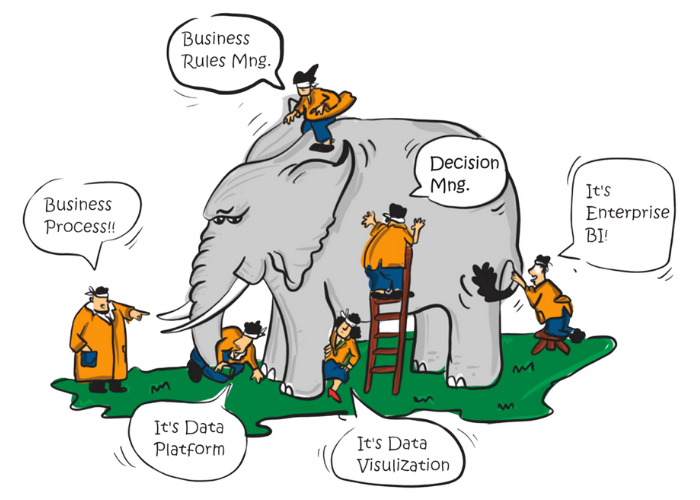
These technologies all exist in organizations but in siloed and disjointed spaces, with different mindsets and within different teams. They all approach the decision-making problem like our famous elephant.
These siloed approaches, tools, and technologies escalate the narrow-window thinking, which causes inefficacy and sub-optimal outcomes, as well as internal bottlenecks and politics in organizations when it comes to making and executing business decisions.
All in all, judgment and decision-making are not getting better!
These issues and challenges have not been addressed in a systematic manner until today, and they are getting worse. As a result, a whole new approach to utilizing multiple technologies and disciplines has been taken to address all of those challenges.
Decision Intelligence is born!
Historically, many disciplines and technologies have supported different aspects of decision-making. Decision Intelligence is an attempt to bring together different practices such as statistics, computer science, data science, operational research, and so on. Decision Intelligence (DI) is a convergence of all relevant techniques in each of these fields, bringing them together with the intent of creating a discipline to help organizations understand and reengineer how decisions are made and how their outcomes are evaluated.
Decision Intelligence is not about data, machine learning, business rules, orchestration process, analytics, insight, and so on. It is a framework for making decisions that are not biased and have as little noise as possible. It uses data to make decisions and not justify already-made decisions.
Book a Custom Demo
How the Decision Intelligence is going to help?
Decision Intelligence (DI) is a thinking framework that allows organizations to have a cohesive and integrated approach to making, executing, and evaluating business decisions. On its own is a very good step on how to think about business decisions but, as many things in today's life, technology can help. A Open Decision Intelligence Platform is the technology that empowers organizations to implement DI practices from the individual level, to teams, functions, and across the enterprise.

The Open Decision Intelligence Platform, or DIP, puts the holistic and hierarchical decision model at the center of decision-making in organizations, whether it is a repetitive, high-volume decision or a complex decision that happens once in a while. Whether it is a rule-based decision or a data-driven decision, every business decision must require a decision model.
Last updated February 17th, 2026 at 11:53 am Published August 1st, 2024 at 09:36 am