Capture core organization knowledge that guides
organizational behavior, decisions, and actions.
Empower your business, SMEs, Operation and IT teams with standardized common language.
Decision Model and Notation (DMN) with Conformance Level 3 guarantees clarity, transparency alignment and agility.

Agility and adaptability
Rules and decision management platform give organizations the flexibility to respond quickly to change. Teams can adapt to new products, policies, or market conditions without rewriting or redeploying applications and processes. Business users can create, update, and test rules without reliance on software development team and IT shortening the cycle from idea to execution and deployment.

Consistency of outcomes
Consistency comes from consolidating business rules engines (BREs) at the enterprise level and centralizing all business rules and decisions in centralized repositories to manage them outside of application code and process models. This ensures every system and process uses the same logic, eliminates duplication, and delivers consistent, predictable, and reliable outcomes across the organization.

Compliance and audit
Rules management provides the transparency and traceability needed for regulatory and policy compliance. Every decision can be explained, audited, and adjusted as regulations evolve. Organizations can easily prove how decisions are made, why they were made, and ensure changes are applied instantly and uniformly, reducing risk and ensuring ongoing compliance.
Enabling non-technical teams to create, update, test,
and deploy rules without reliance on IT
Apply changes in hours, not weeks.
Visual, Graphical Interface:
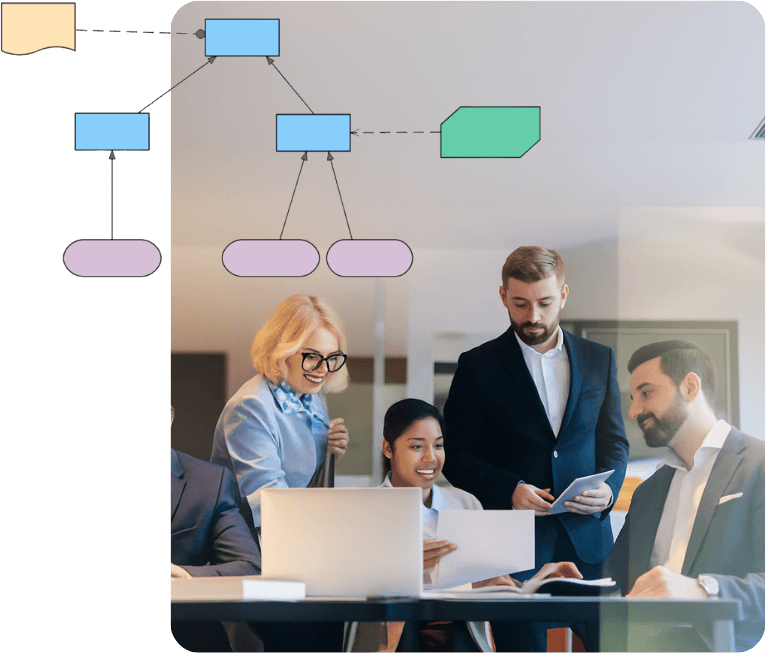
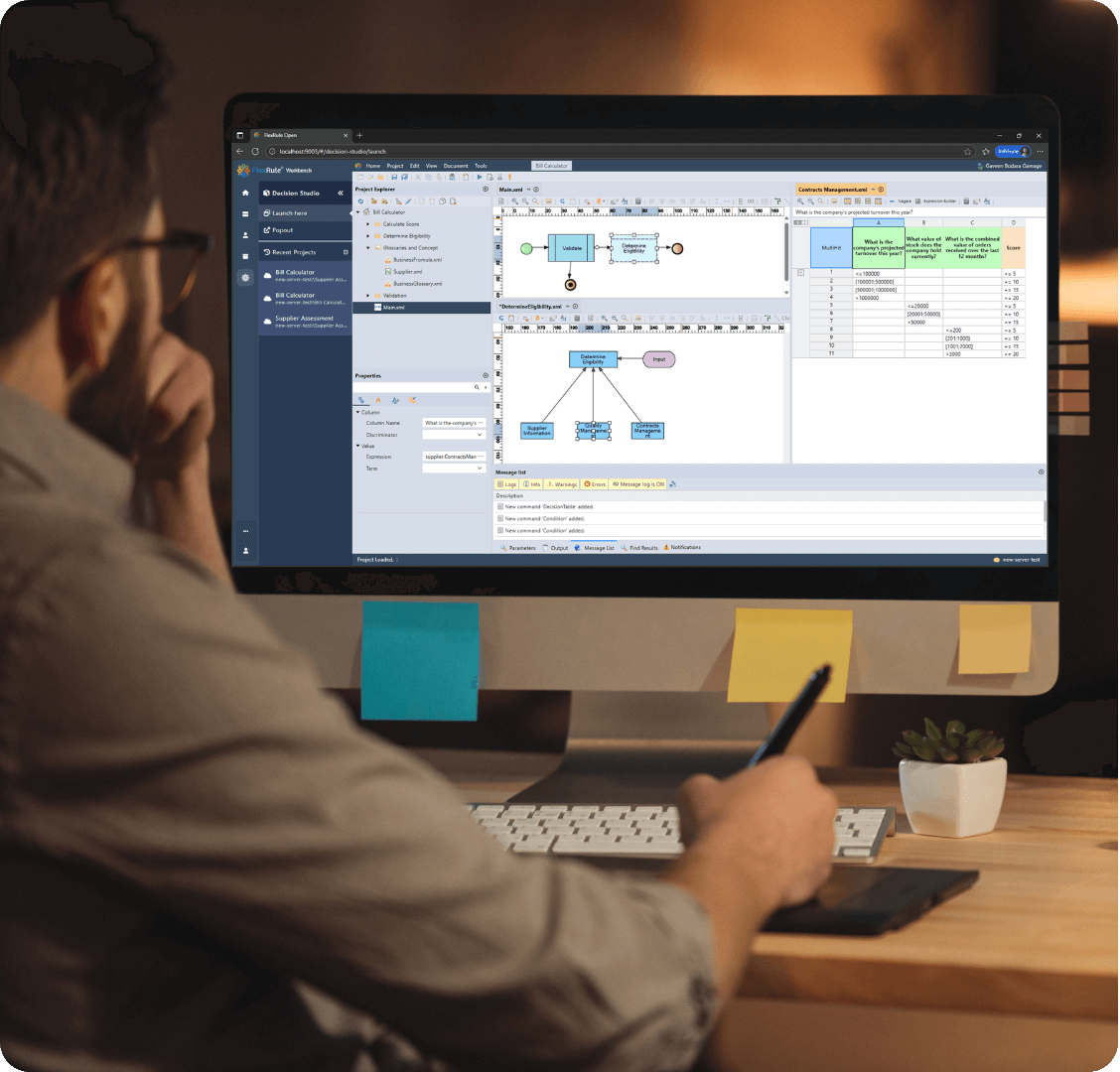
Business agility starts with visibility. When business logic is hidden in code, organizations slow down and decisions lose alignment. A visual, low-code environment brings that logic into the open. Both business and technical teams can see, understand, and adapt decisions together.
- User-friendly and intuitive no-code/low-code
- Build domain knowledge with business terminologies and concept models.
- Multiple rules modeling techniques (decision tables, natural language).
- Support for non-rule logic like tree-subtree, boxed expressions, formulation, and computation.
This enables faster time-to-change and ensures shared understanding via common language (Decision Model and Notation – DMN with Conformance Level 3).

Safe, Flexibility and Dynamic Execution:
Dynamic and yet safe and fast execution enables ease of change without rigidity of static rules. Changing course as new data, contexts and event emerge is on your finger tips.
- Static and semantic analysis of models for correctness and completion.
- Built-in quality assurance UI and framework.
- Extendable via DecisionLang superset of FEEL/DMN.
- Dynamic decision graph and runtime logic resolution (Dynamic Routing).
- Advanced data operators for data validation, composition, and enrichment.
- Extensibility by extensions development (Open SDK) and custom code (C#, Python and JavaScript) executing.
Respond instantly to new conditions and circumstances while ensuring safety of required changes and extensibility for technical team.
Multiple Authoring Environments:
Enterprises can’t scale business rules and decision management if authoring is limited to one type of user. By providing the right tools for both business and technical teams, organizations can collaborate efficiently, reduce delays, and improve delivery throughput.
- User-friendly Web-based environment for SMEs without local installs using visual editors and no-code/low-code.
- Intuitive IDE for technical team for advanced tasks like data pipelines and end-to-end orchestration.
- Versioning and control inside your enterprise change management workflows.
- Integration with Decision Asset Management as the centralized collaboration and repository.
- Native integration with user-friendly UI for GIT server (GitHub, GitLab, Azure DevOps etc).
Enable business participation, SMEs collaboration and IT control with the right tool for each user group.

Operationalization and Execution Anywhere:
Your decisions should run wherever your business runs; cloud, on-premises, or hybrid. Open deployment makes operations location-agnostic while integrating with DevOps pipelines to ensure every change is governed, tested, and deployed with confidence.
- Deploy on virtual machines, Docker containers (including Kubernetes), on-prem, cloud, or serverless (Azure, AWS, Google).
- CLI toolkit for DecisionOps to integrate with CI/CD pipelines and streamline change management.
- Execute rules and decision In-Proc (Client, Server and JavaScript) or as-a-service via REST API.
Run decisions seamlessly across hybrid environments with freedom of deployment, operational continuity and ownership of your organizational knowledge and your data.
Governance, Clarity, and Transparency:
As automation scales, so does the risk of “black box” decisions. Governance ensures not only that rules are followed, but that every decision remains explainable and defensible — a necessity for compliance, trust, and operational confidence.
- Highest DMN conformance (Level 3).
- Live debugging capability for transparency during development.
- Ensures decisions are explainable, auditable, and defensible.
Clear visibility from design to execution ensures operational trust. Standardized modeling (DMN CL3) guarantees regulatory confidence, compliance by design.


Critical Capabilities for Business Rules and Decision Management
Apply changes in minutes and hours, not weeks and months.

Common Language
Decision Model and Notation (DMN) with Conformance Level 3 guarantees that business, operations and IT, understand and build logic in a standardized and easy approach.

Decision Model
Focus on modeling business decisions to eliminate the ‘big bucket of rules’ problem as your business rules grows and avoid ambiguity.

Flexible Business Rules
Use multiple business rules modeling technique where fits best. Tabular form for structured and policy-driven to tree and natural language for more nested logic and calculations.

Data Integration
Enable your decisions and rules to directly access and gather the data from wide ranges of connectors i.e. database, services, files and more.
Learn more about Business Rules and Decision Management

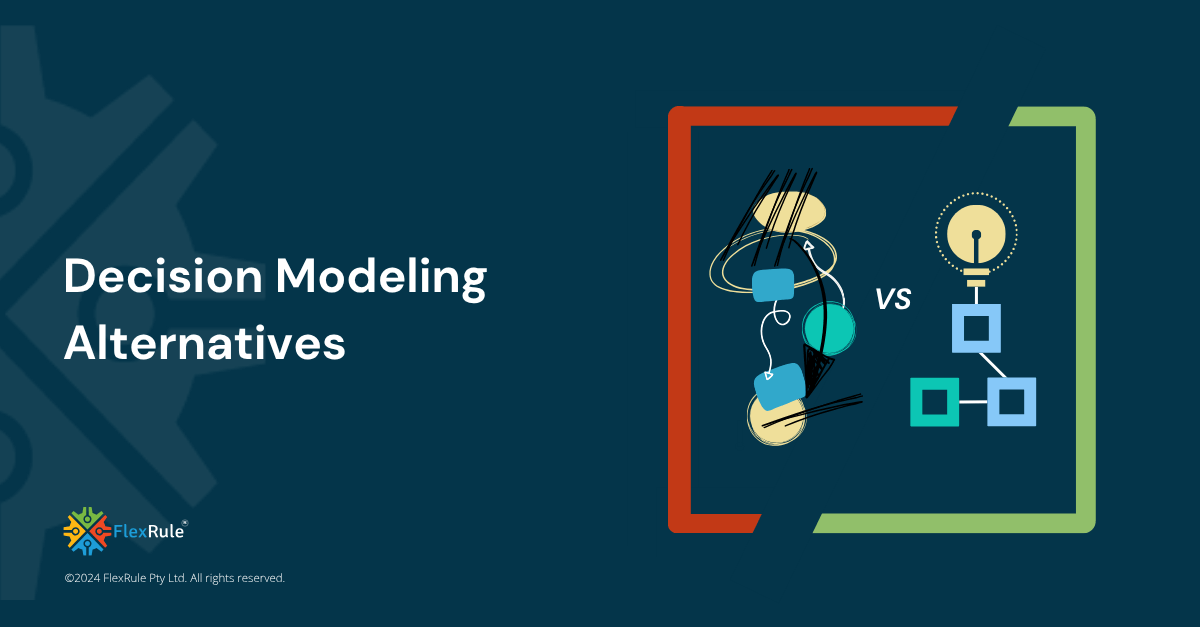
Is doodling for brainstorming enough for you? Or do you need to enforce clarity, transparency and governance.

How to model Business Decisions? What is the overall process of capturing a decision and its related critical components?