LiveContext
Reusable, contextualized and governed data transformation and retrieval for decisions, processes, and AI agents.


What is LiveContext?
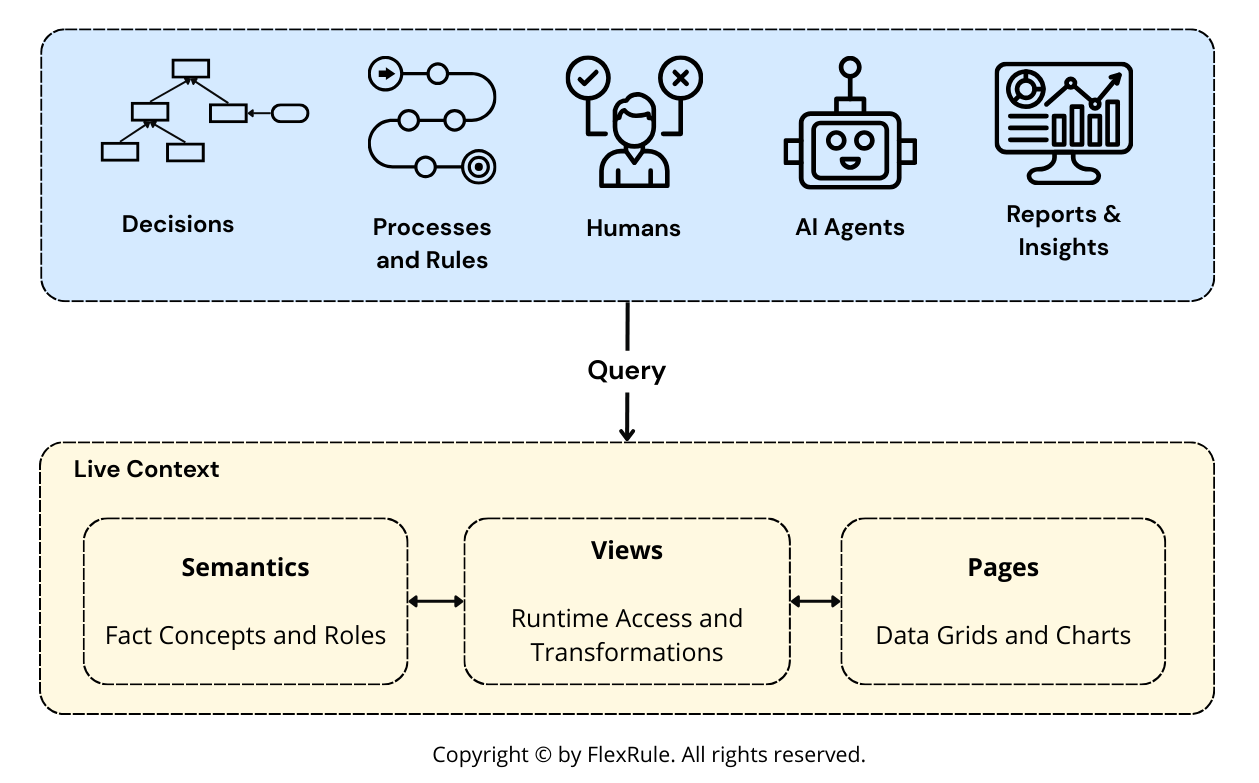
LiveContext is the decision-ready context that brings meaning to data by organizing and shaping it for decision-making. It assembles the datasets required for decisions, processes, and AI agents into a coherent runtime structure that is composite, navigable, queryable, and governed by explicit semantics and policies.
The Origin of LiveContext
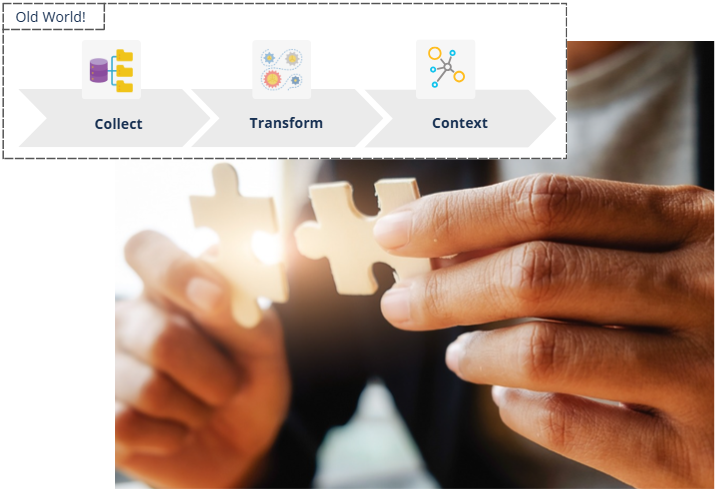
Context is critical for decision-making.
Yet most teams create context by stitching data and systems together through automated workflows, ETLs, data pipelines, and handcrafted ad-hoc queries.
As decisions need to scale and governed, this traditional approach becomes messy, procedural, repetitive, time-consuming, heavily dependent on strong data and programming skills, and highly error-prone.
So we built LiveContext. Our patented innovation that uses a familiar tabular interface to let users navigate data and build context automatically.
LiveContext’s mission is to enable teams to move from BI to DI (Decision Intelligence) frictionlessly.
Increase Reusability, Improve Consistency, and Guarantee Governance
Traditional Context Building
- Data is stored as isolated values without meaning.
- Semantics (filters, joins, relationships) live in SQL or pipelines.
- Context is stitched through ETL, workflows, and manual work.
- Inconsistent meaning depending how it is understood and who uses.
- Each decision team recreates its own version of “context”.
- No clear separation between raw data and the semantics.
- Governance is reactive so is applied after the fact, not built into it.
- Decisions rely on assumptions as data lacks defined relevance.
Offline, procedural, messy and repetitive data preparation prone to errors, inconsistencies and is time consuming.

With LiveContext
- Context is defined explicitly by structure, semantics, and relevance.
- Data semantics (types, relationships, constraints) are not hidden.
- Decision-ready datasets are unified, not scattered in pipelines.
- Users navigate a reusable context, not datasets or tables.
- Semantics are declarative and separated from physical data layer.
- Queries are declarative so users specify intent not how to retrieve.
- Governance is built in, transparent, consistent and global.
- Decisions operate on contextualized meaning, not raw values.
Unified decision-ready datasets to provide consistency, eliminates repetitive work, and increases productivity.
Business Value of LiveContext
Accelerate the Move from BI to DI
LiveContext removes the friction between insights and action by providing a tabular interface to build decision-ready context. It makes decision models easy to connect contextualized and governed information and insight without requiring code and workflow.
Increase Productivity and Simplicity
Provides a reusable decision-ready context across various scenarios and workflows. LiveContext enables users to visually connect to various data sources and declaratively navigate and query data without dealing with the underlying complexity.
Improve Governance and Traceability
The explicit definition of the semantic layer such as Facts Concepts, declarative and explainable queries, roles and relations outside of physical data layer ensures everything is transparent, consistent and governed.
Reducing Errors and Inconsistencies
By defining a reusable context explicitly, LiveContext eliminates repetitive manual data preparation, transformation and interpretation. As a result, it reduces inconsistencies and minimizing errors caused by ad-hoc or scattered data handling.
From Batch and Offline to Real-Time
LiveContext reduces the reliance on batch pipelines and offline data preparation by assembling decision-ready context in real time. Information and insights become immediately usable within decisions, without waiting for scheduled processes or manual workflows.
Meet LiveContext
Smart and reusable context layer for decision-making.
Multiple Data Sources
Structure and organize disparate data sources from various systems, databases and services.
LiveContext connects to various data sources across your organizations. Then it assembles all the datasets required for a decision into a coherent, decision-ready context that can be navigated, queried, and consumed at runtime.
These data sources can be cross-boundaries and across wide ranges such as
- Databases
- Online services and applications
- Flat files (XML, JSON, CSV…)
- Operational databases
- Systems and Workflows
Uses built-in transformation capability to create decision-ready data sets, unifies them into a single view, and allows that context to be reused across multiple scenarios and processes.
Technical Value and Benefit:
Unified Data Abstraction: Consolidates disparate data sources (databases, files, services) into a single, cohesive view, shielding decisions and processes from underlying data fragmentation.
High Reusability: Defines the data context once and allows it to be leveraged across various decision-making scenarios and processes without re-implementation or writing ad-hoc queries.
Simplified Data and Insights Preparation: Operationalizes the transformation of raw data into “decision-ready” formats directly within the decision platform, reducing dependencies on external ETL pipelines.
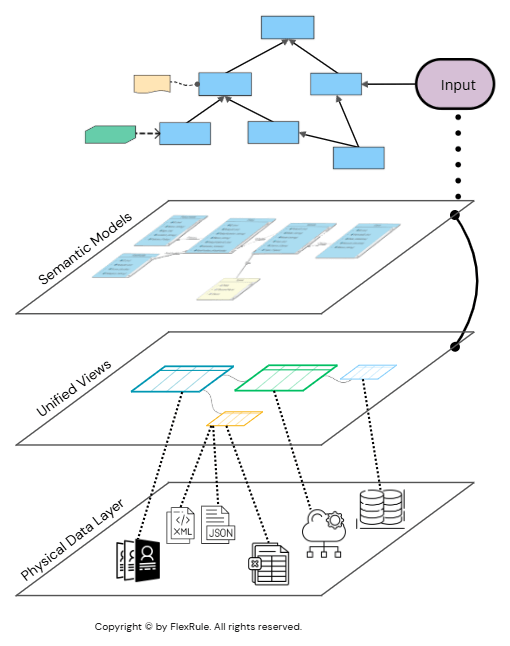
Semantic Modeling
Semantic Models to guarantee clarity, consistency and transparency.
Live Context introduces a powerful Semantic Model Layer that fundamentally changes how your decision logic interacts with your data. By specifying data semantics completely outside of the physical data layer, it insulates your business rules from the complexities of underlying databases.
This layer is built on two core pillars:
Fact Concepts: These define the structure and navigation of your data, turning raw tables into intuitive business entities like Customer or Order. This allows users to navigate data naturally at design and modeling time (e.g.,
Customer.Address) without needing to understand database schemas.Role Relations: These explicitly define the relationships between concepts, replacing technical foreign keys with clear business associations.
You can migrate or change data sources without breaking your rules, and business users can define logic using terms they understand, ensuring consistency and agility across the enterprise.
Technical Value & Benefit:
Decoupling Logic from Data: Decision is modeled against the semantic model, not the physical database. This means you can change the underlying data sources (e.g., move from SQL to a flat file, or service) without breaking the models.
Business-Centric View: It translates technical data structures (tables, columns, keys) into business-friendly terms (Concepts and Roles) that subject matter experts can understand and navigate.
Consistent Definitions: Ensures that business terms e.g. “Customer,” “Risk,” or “Eligibility” mean the same thing across all decision models, regardless of where the data comes from.
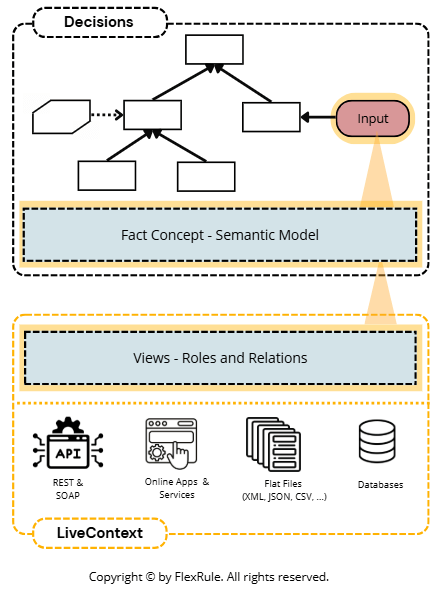
Smart Queries
Unified and smart data retrieval for both technical and business user groups with built-in optimization.
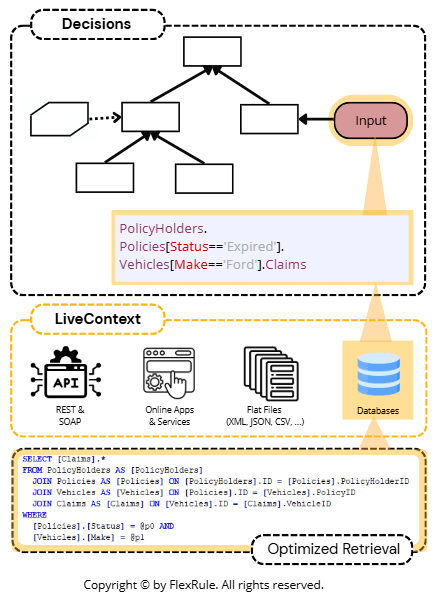
Live Context powers Smart Queries by directly leveraging the Semantic Model to bridge the gap between business logic and data execution. Instead of static scripts, it enables dynamic navigation of complex data structures, allowing the system to traverse deeply nested hierarchies using Fact Concepts and Role Relations.
By understanding the context, the engine automatically uses Role Relations to apply precise joins and filter child hierarchies, ensuring that only relevant data associated with the specific parent record is retrieved. Perhaps most powerfully, it creates Unified Queries via decision language expressions. This allows the exact same logic to run transparently either directly on the database (for maximum performance) or in-memory, without the user ever needing to write a single line of SQL.
Technical Value & Benefit:
Optimized Performance via Push-Down: By translating DecisionLang expression directly into database queries, it minimizes data movement and leverages the database engine for heavy lifting.
Automated Data Integrity: The automatic filtering of child hierarchies based on parents ensures that the data context remains accurate and relevant without requiring manual “where” and “join” on the data.
Abstraction of Complexity: Users can write data logic against a clean semantic model, while the LiveContext handles the complexity of physical joins, keys, and memory management in the background.
Data Governance and Traceability
Built-in Data Governance in Decision-Making Scenarios
Live Context establishes a robust governance framework by enforcing a single source of truth, centralizing all data definitions within the Semantic Model using Fact Concepts and Role Relations. This architecture creates a strict, managed definition layer that bridges the gap between your physical data sources and business logic, ensuring consistency across the enterprise.
Beyond simple definitions, it automatically tracks the full dependency graph of your decision-making ecosystem. It links every single business rule back to the specific Fact Concepts and underlying data attributes it consumes, providing complete visibility and ensuring that data usage is always transparent and traceable.
Technical Value & Benefit:
Granular Lineage: Provides end-to-end visibility, allowing you to trace exactly which data element contributed to a specific decision outcome (e.g., “This loan was rejected because this specific bureau score field was used”).
Auditability & Compliance: Removes the “black box” of data and insight preparation and usages. Because transformations, relations and definitions are explicit in the model (not hidden in SQL scripts), every usage is fully auditable and compliant with regulatory standards.
A Composite AI model is built from many parts.
Discover the rest here…