🚩Operational business decisions are so implicitly intertwined in daily operations that sometimes they don't feel like decision-making.
Business decisions are part of everyone's daily job and are crucially important as they determine the success of business operations. The quality of their outcomes directly influences business objectives such as customer satisfaction, compliance, revenue targets, and so on.
💡These business decisions are across a broad range of daily activities in all industries and sectors. Below are some examples in the insurance industry:
– Is claim the claim ready for processing?
– How much is the premium of a car?
– Should we ensure this particular quote?
– Who should pay for recovery in an accident?
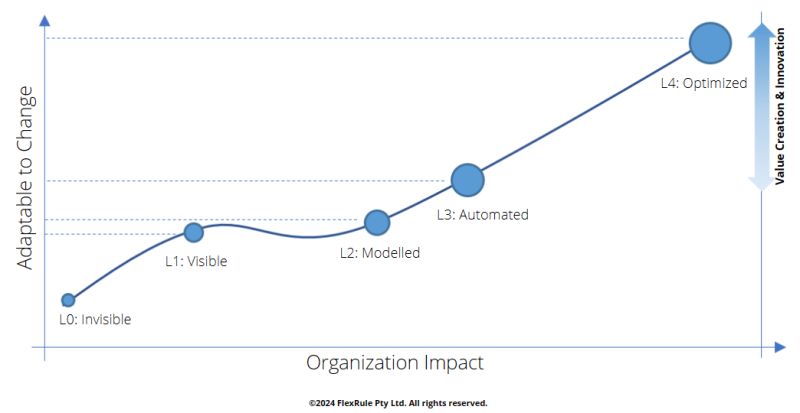
✨One of the main goals of the Decision-Centric Approach® is to ensure that these decisions are optimized, situation-aware, and customer-centric. To do that, it needs to determine the maturity of the decisions in operation. As their maturity grows, the impacts increase, and they become more adaptable to change.
Operational business decisions have five levels of maturity – the maturity mode for operational decisions:
🔹L0 Invisible: They are not visible as part of the operation. Therefore, the organization risks losing intrinsic knowledge about how the business operates.
🔹L1 Visible: Teams are aware of them and very explicit about them; however, they are scattered across processes and systems and are not managed properly.
🔹L2 Modeled: The operational decisions are modeled, and the organization is aware of how they are made. Still, changing them requires too much effort across processes, procedures, and systems. The outcomes are still inconsistent because of the noise.
🔹L3 Automated: The decisions are fully or semi-automated. They produce consistent outcomes and can be shared across systems and processes. Yet, they are not necessarily optimized for all situations, and their impacts are not measured.
🔹L4 Optimized: They implement the full decision cycle and are optimized to create the best outcome for the organization and customers. They are monitored, and their impacts are measured based on the metrics and associated business KPIs they influence.
🚀Organization leaders should aspire to reach the L3 (Automated) and L4 level (Optimized) of maturity for their business decisions so that they can adapt to change Quickly, produce Accurate and Consistent outcomes, and be Transparent (Quick ACT® Decisions). More importantly, at the maturity level of L3 and L4 teams, they have a significant contribution to value creation by driving innovation.
➡️ Learn more about the Decision Maturity Model at https://lnkd.in/gaUhRj9i
–
Follow me if you’re looking for unfiltered insights into DecisionIntelligence, AI, and DecisionAutomation. Hit the 🔔 on my profile to get notified about my daily posts.
Posted here.
Published February 15th, 2025 at 07:30 am