AI agent governance is frequently perceived as a “Big Architecture” and engineering overhaul. It is framed as a massive program requiring organizations to map every system, process, and data source before a single agent can go live. This approach is not just expensive; it is structurally flawed because it treats governance as a static documentation exercise rather than an active control and alignment mechanism.
The Decision-Centric Approach® provides a faster, more surgical alternative. Instead of attempting to govern the entire enterprise, the engineering effort is focused on the action boundary.
Two Questions to Rule the Action Boundary
To move from abstract policy to executable control, the organization only needs to answer two questions for any high-risk agent action:
- The Control Question: What decision determines whether this agent is allowed to take this specific action?
- The Traceability Question: What decisions and context led the agent to attempt, recommend, or select that action in the first place?
The first question provides immediate risk mitigation by placing a governed checkpoint at the point of execution. The second provides the forensic path required for auditability and explainability. Together, they form a practical governance starting point that requires no enterprise-wide overhaul.
Starting with these two questions directly supports the Quick ACT™ framework: agents can act in high-value streams and high-stakes operations only when their actions are controlled, traceable, and aligned with the decisions that govern them. This is especially important in regulated industries such as banking, insurance, and financial services.
The Business Case: Beyond Risk Reduction
Executives should not fund governance purely to avoid disaster. While risk reduction is a baseline requirement, the true ROI of this approach lies in the creation of a high-performance operating model.
By engineering governance at the decision layer, the organization achieves five strategic outcomes:
- Elimination of Decision Debt: When logic is scattered across prompts, APIs, and scripts, every policy change becomes a “search and fix” project. Centralizing logic into governed decision assets pays down this debt.
- Avoidance of Duplicated Controls: You stop paying to build the same logic twice. One governed decision can be reused across multiple agents, bots, and legacy applications.
- Improved Speed of Change: Business owners can update policies (for example, changing a credit threshold or a geographical restriction) without needing a developer to refactor the agent's code.
- Reusable Governance Capability: Each implementation builds a modular, executable asset. Governance becomes a library of services rather than a pile of manuals.
- Reduced Engineering Effort: By narrowing the scope to the action boundary, the first deployment is measured in days. You are not rebuilding the workflow; you are simply governing the exit point.
Separating the Workflow from the Policy
A common engineering mistake for the AI agent governance implementation is to take a shortcut and bury governance logic inside as a control gate inside workflow. This approach is cheap on day one but ruinous by the end of year one.
Workflows and decisions have entirely different lifecycles. A workflow manages how work moves (owned by Operations and IT). A decision determines if an outcome is correct or allowed (owned by Risk and Compliance).
When these are coupled, every regulatory update forces a process redesign. The Decision-Centric Approach® keeps them separate: the workflow routes the work, but the decision before the gates holds the logic where it should be routed and the veto power. This separation of concerns is what allows the organization to scale AI autonomy without losing control and business alignment.
AI Agent Governance Implementation
Although the four-layer architecture may seem like a big, expensive, and ambitious approach to decision governance for AI agents, the intent is the opposite.
The purpose is to give engineering and governance teams a disciplined structure and practical tools to tackle one problem at a time.
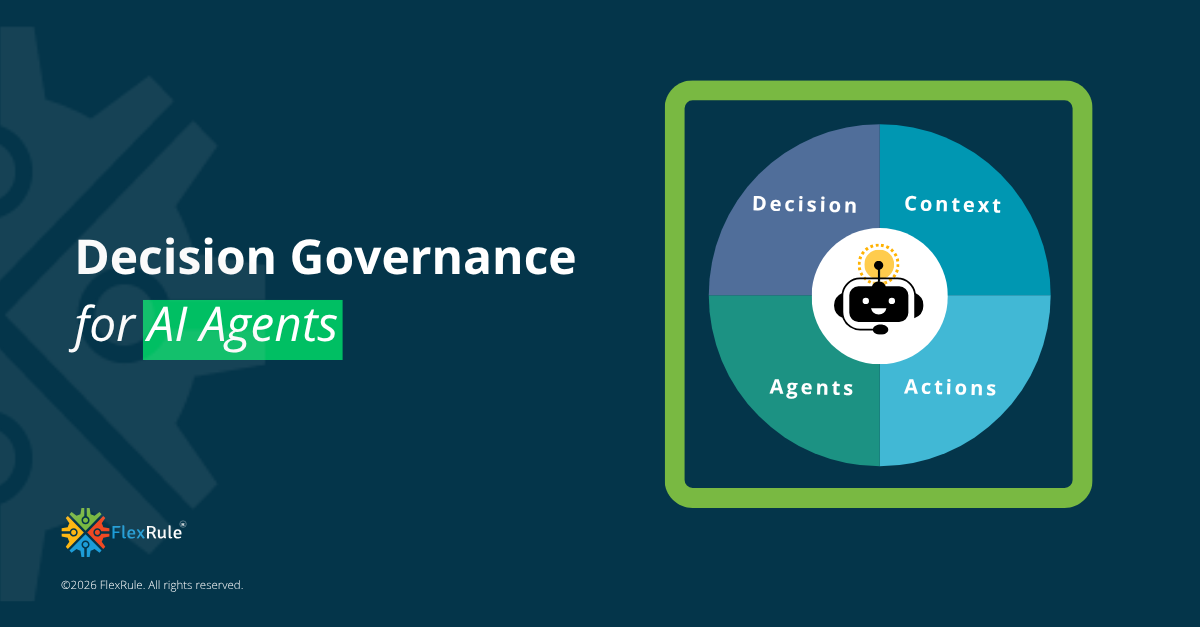
By separating the agent, context, decision, and action layers, teams do not need to redesign the whole enterprise. They can focus on one high-risk agent action, define the decision that controls it, provide only the context required for that decision, and enforce the outcome before execution.
This increases efficiency because each governed checkpoint becomes a reusable capability, not another local control buried inside a workflow, prompt, script, or application.
This architecture keeps the engineering footprint small by separating the following concerns:
- The Agent Layer: Who is asking?
- The Context Layer: What specific data is needed for this decision?
- The Decision Layer: Is the action allowed based on current, versioned policy?
- The Action Layer: The enforcement of the “Yes” or “No” before any system of record is touched.
By applying this to one high-risk action at a time, the organization avoids the “boil the ocean” syndrome. The workflow does not become a rule engine. The agent does not own the policy. The application does not need a rewrite.
What Good Looks Like
Successful implementation of AI agent governance is not measured by the volume of governance documentation. It is measured by whether the organization can point to a high-risk agent action and answer three questions:
- Why did the agent arrive at this action?
The decisions and context that led the agent to attempt, recommend, or select the action are traceable. - Was the agent allowed to take it?
The action is governed by an explicit, visible business decision before execution. - What evidence was used to decide?
The context, decision result, evidence, and action outcome are captured at the moment of execution.
That is the standard: the decision path is traceable, the action boundary is governed, and the evidence is available.
Book a Custom Demo
Conclusion
Decision governance for AI agents is an investment in business agility and risk mitigation at the same time.
By starting with the decision boundary and the two core questions of control and traceability, organizations can avoid the overhead of enterprise-wide redesign. They get the control they need today and the reusable governance capability they need for tomorrow.
In 95% of organizations value and financial results are driven by decisions they make and execute. Therefore, the “gap” between data, insight, from action is the decision. To align and control outcomes, organizations need to govern the decisions that shape those outcomes:
- the decisions that lead agents toward an action, and
- the decision that determines whether the action is allowed.
This is the only practical path enabling organizations to align and control outcomes by governing decisions and consequently, let agents work safely and in compliance.
Read More
Last updated July 31st, 2026 at 11:24 am Published May 19th, 2026 at 01:43 pm