It's no longer a niche technology, but a mainstream imperative!
Last year, I predicted that Decision Intelligence (DI) would go mainstream. While it didn’t happen as aggressively as I thought, the progress has been undeniable. DI has gained serious traction—vendors are investing, consulting firms are paying attention, and even universities have started offering official courses on DI.
Three major consulting firms—Gartner, IDC, and QSR Group—published reports on DI this year, and FlexRule was featured in all of them with high rankings. I’m incredibly thankful to our customers, partners, and team for making this happen.
2024: A Year of Noise and Progress
This year, AI and large language models (LLMs) stole the spotlight, with companies pouring resources into them. Unfortunately, much of that investment was misplaced and hyped up by big tech companies.
Meanwhile, DI quietly but steadily became the core technology for decision-making in industries like banking, insurance, government, and financial services.
What’s Holding Back DI?
Adoption is slower than it should be because of all the noise around AI. Still, I’m optimistic. Companies that rushed into LLMs and GPT are now realizing the real challenges: high costs, lack of transparency, and hallucinations. These problems make it impossible to use these systems in critical business operations or regulated environments. These issues aren’t bugs that can be fixed—they’re by-products of the transformer and neural network architecture.
Failure is often the best teacher.
The Data Problem
We’ve heard it for years that “data is the new oil!” and “garbage in, garbage out.” Sure, that’s true, but it’s often just a way to keep the focus on data while riding the AI hype. Let’s be real—data has no intrinsic value nor is the issue of most companies and businesses.
A RAND report found that more than 80% of AI projects fail, and the top reasons aren’t algorithm accuracy or data quality. It’s because they don’t solve real business problems or deliver actual business value.
Decision-Making Is the Real Problem
Here’s what’s interesting: everyone—AI, LLM, GPT, and data advocates—claims their technology improves decision-making. This shows that companies are shifting their attention from flashy tech to the deeper operational need for better decision-making.
But let’s not miss the point: neither data-driven approaches nor AI technologies are designed to solve this problem. The missing link between decision-making and AI, Data and Algorithm is “decision modeling”.
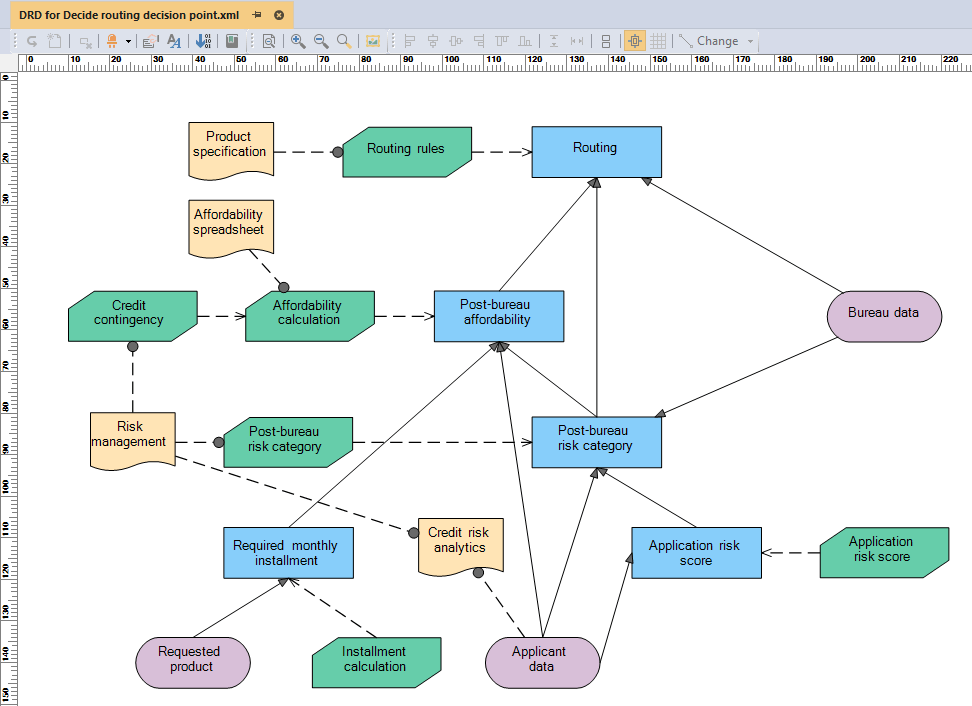
Sure, it’s fun to see computers respond like humans or answer questions, but real decision-making in business requires rules, policies, and domain knowledge — while following procedures.
Just like humans, systems, AI, and Agents need a structure to operate based on organizations’ procedures.
Where Decision Intelligence Fits
This is what DI does best. It explicitly models how decisions are made in a business operation making it possible for humans, systems, and even AI to work together. DI based on Decision-Centric Approach® ensures Quick, Accurate, Consistent, and Transparent business decisions (Quick ACT™) by pulling together data, rules, policies, and domain expertise via explicitly modelled business decisions. This becomes the executable models using Decision Model and Notation with Conformance Level 3 (DMN CL3) and the basis of decision automation and augmentation for integrated approach in business rules, predictive analytics and machine learning.
It’s not about following the hype—it’s about solving actual problems. DI helps businesses navigate complexity, deliver value, and adapt quickly when things change while remaining focused on business objectives and reducing risks.
Book a Custom Demo
Looking Ahead
The work isn’t done. DI has made progress, but there’s still so much potential to unlock. In 2025, we need to focus on cutting through the noise and showing the tangible value DI brings.
For businesses, it’s about solving real operational challenges: meeting regulations, managing risks, and mass personalization, faster adapt to change. DI’s role is clear—it helps companies get their act together when it comes to decision-making, whether it’s people, systems, processes or even AI Agents.
2024 was a year of laying the foundation. 2025 will be about scaling up and proving just how much DI can do.
Thank you for being part of this journey. Let’s keep building together.
— Arash Aghlara
P.S. Please click ➡️here and follow me on LinkedIn if you are looking for unfiltered views into #decisionintelligence #ai.
Last updated February 17th, 2026 at 11:54 am Published December 19th, 2024 at 01:08 pm