DORA is in force. The EU AI Act high-risk deadline is August 2026. OSFI E-23 comes into effect in May 2027. And these are just the ones we know today. Regulators across every industry and jurisdiction are converging on the same question: can you show us the decision that produced this outcome? An AI agent governance platform that governs all four layers, decisions, context, actions, and agents, is the only complete answer, today and for whatever regulatory frameworks come next for agentic AI.
This article builds on The Missing Link in AI Governance. If you haven't read it, start there.
Why AI agent governance. Why Now.
There are three independent reasons an organization arrives at AI agent governance platform. Any one of them is sufficient. Many organizations face all three.
Reason 1: Regulatory Requirements
There are several regulations that are forcing organizations to govern not only the technology they use, but the decisions and outcomes those technologies produce.
The direction is clear. It is no longer enough to show that a model was tested, a dataset was approved, or a process was documented. Organizations must be able to explain how an outcome was produced, what information shaped it, what logic governed it, what action followed, and who or what was accountable.
That is why decision governance for Agentic AI is becoming a regulatory necessity.
- DORA has applied since January 2025. Articles 28 through 44 establish a structured regime for ICT third-party risk management and oversight. For AI-enabled financial services, this means governance cannot be delegated to the model, cloud, or LLM provider. It must be built into the architecture.
- The EU AI Act high-risk deadline is August 2026. Human oversight under Article 14. Explainability under Article 13. GPAI obligations under Article 53. Organizations deploying AI in high-risk contexts have months, not years.
- OSFI E-23 comes into effect in May 2027, and Canada's Directive on Automated Decision-Making is already in force. Together, they require model risk management, human oversight, and audit trails across the decision lifecycle.
The common thread across every framework is the same:
These questions cannot be answered by a data platform, decision intelligence platform or an AI model. They can only be answered by a AI agent governance platform that governs all four layers of the full decision cycle plus, how they evolve across time and multi-actor environments.
Reason 2: Black Box by Nature
Probabilistic models are black box by nature, not by accident. The logic is not hidden because vendors chose not to expose it. It is hidden because there is no logic to expose. The model operates on statistical weights across billions of variables. There is no If/Then rule, there is no definition for ground truth. Adding more data as semantic or ground truth still becomes part of the system itself.
Therefore, there is no traceable path from input to output. What looks like reasoning is a linguistic projection, not the actual cause of the output. When you ask for an explanation (Chain of Thought), the model generates a new string of text that sounds like a justification for an answer it already calculated. The explanation and the answer are two separate statistical outputs. The chain does not cause the answer. It narrates it.
You cannot translate a high-dimensional vector space into auditable logic. Context Graphs and trace-based architectures attempt to work around this by adding memory to the output. But memory is not governance logic, it's just more data to the same system of high-dimensional vector space.
A decision that was never modeled explicitly cannot be governed retroactively. This matters most when decisions enter prime time: regulated, irreversible, personally impactful, or contractually binding. In these conditions, a black box is not a technical limitation. It is a liability.
The answer is an explicit decision model, where the logic is the governance, not an afterthought.
Reason 3: Control and Align Outcomes
Despite heavy investments in data, dashboards, business rules, AI, and process automation, most organizations still struggle to make decisions that are Quick, Accurate, Consistent, and Transparent (Quick ACT™). The problem is not the tools. It is that decisions are not treated as first-class assets.
This shows up in four ways:
- Stuck at insight: Data, reports, and dashboards remain at the insight layer and go unactioned. Data is used to justify decisions, not drive them. The gap between knowing and deciding is never closed and doubles down on human confirmation bias.
- Misaligned outcomes: Process and rules-driven automation hide the decision and owns its lifecycle. Decision logic is scattered across systems, hardcoded, or buried inside workflows. The process runs and produces consistent outcomes. The issue is outcomes drift from intent and become misaligned with organizations objectives. Consistent execution is not the same as aligned and controlled outcomes.
- Loss of decision knowledge: Decisions are treated as afterthoughts, not as organizational assets. Their lifecycle is tightly coupled with processes, systems, and people. When those change, the reasoning disappears with them. No explicit model. No independent lifecycle. No way to know why things are done the way they are.
- Solving the wrong problem: Data and AI teams optimize for the wrong objective because the decision was never made explicit. Models are built around available data and technical metrics, not around the business decision that needs to be made. Projects deliver outputs nobody acts on. Investment without business value.
AI agent governance makes decisions explicit, independently managed, and connected to outcomes. Not just for compliance. For the 95% correlation between decision effectiveness to financial results and organization values.
Govern full Decision Cycle for AI agents
The basic of an effective decision is outlined by the full decision-cycle. Always all effective decisions whether automated or manual, follow the same cycle: Observe → Orient → Decide → Act.
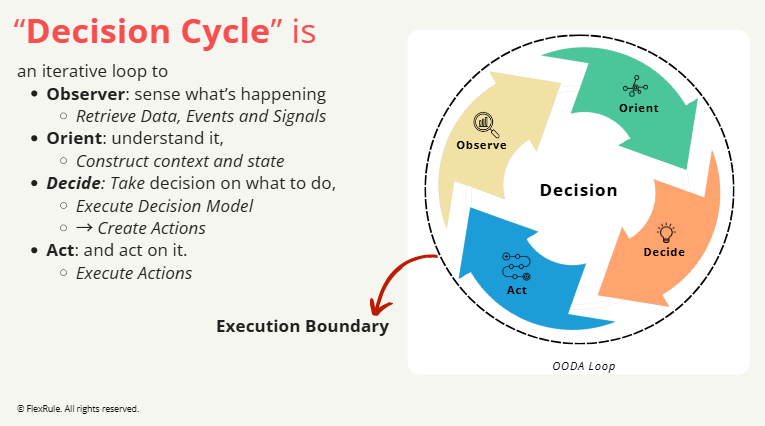
The OODA loop: Observe → Orient → Decide → Act
It's worth mentioning, this is not necessarily a leaner loop.
- Observe: sense what is happening. Retrieve data, events, and signals.
- Orient: understand it. Construct context and state.
- Decide: execute decision logic. Determine what is admissible.
- Act: execute authorized actions at the Execution Boundary.
Govern decisions without context, and logic executes on ungoverned inputs. Govern context without decisions, and quality data feeds a black box. Govern both without actions, and an authorized decision triggers an unauthorized consequence. Govern all three without agents, and actors in the decision continuum across time operate without accountability.
This the defines exactly why governance requires four layers. Not three. Not five. Remove any one and the cycle breaks.
Four layers. One complete cycle. No gaps.
Architecture of AI agent governance platform
Decision governance for Agentic AI requires a very deliberate architecture, because it ensures that governance is not reactive and bolt on. Which means governance not only can mitigate related compliance risks but also produces various reusable organization assets do enhance decision agility in a multi-actor environment.
The four-layer architecture is meticulously designed to ensure Agentic AI governance does not become an engineering overhaul by providing distinct layers for different governance requirements.
This architecture provides a practical and operational layers as part of the business operation and governance requirements ensuring quality and compliance of decisions across various use cases do not degrade while agentic AI efforts scale in enterprise.
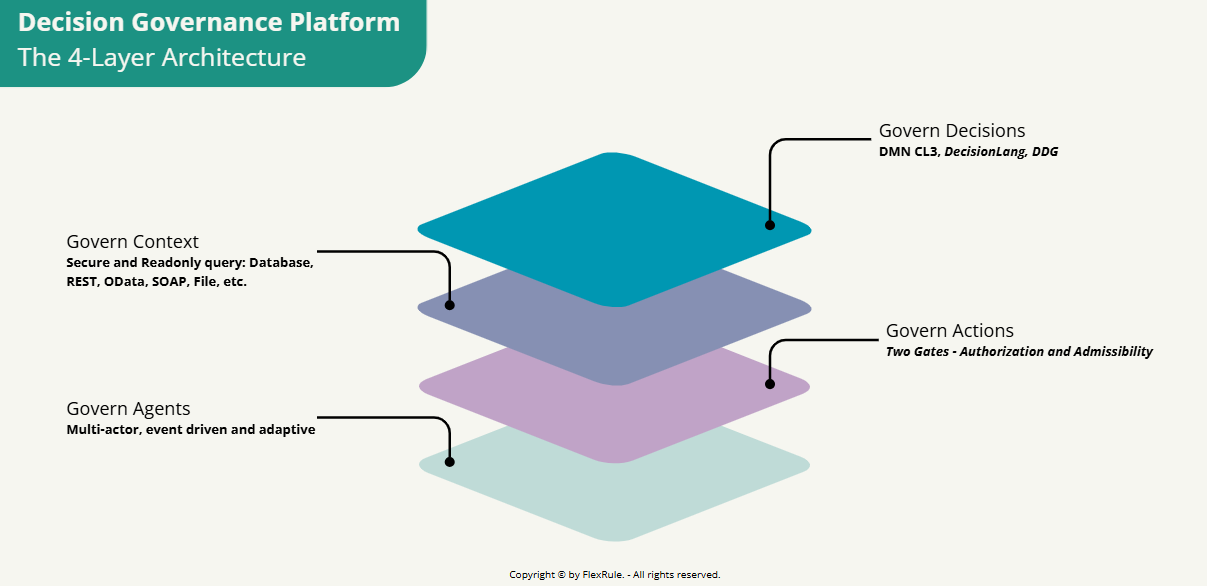
Layer 1: Govern Decisions
Most AI systems make decisions implicitly, hidden inside probabilistic models. The output emerges. Nobody can point to the rule or reproduce the reasoning. Context Graphs and trace-based architectures attempt to fix this by adding memory to the guess, but memory is not governance. A decision that was never modeled explicitly cannot be governed retroactively.
This matters most when decisions enter prime time: regulated, irreversible, personally impactful, or contractually binding. In these conditions, implicit decisions are not just ungovernable. They are a liability.
The answer is to make the decision the first-class citizen from the start. Built on DMN Conformance Level 3, decision logic is human-readable, portable, and directly executable. The AI informs. The decision model governs. Same inputs always produce same outputs. For adaptive, situation-aware decisions, the Dynamic Decision Graph extends DMN with runtime adaptability, supporting both deterministic and probabilistic decisions within a fully governed model.
A regulator can read it. An auditor can validate it. And when logic needs to change, you change the model explicitly, not retrain a black box.
Layer 2: Govern Actions
At the Execution Boundary, the platform evaluates whether the proposed action is admissible for this case, in this context, right now. Independently of the AI model and the process author. Allow, Defer, or Halt.
Admissibility is not a technical guardrail. It is the result of a decision model execution, a business answer to a business question: what actions are appropriate in this specific scenario? Without it, execution is unconstrained and unexplainable.
Layer 3: Govern Context
Most discussions of context for AI agents stop at retrieval: vector stores, RAG, semantic search. But Context Graphs and RAG-based architectures invert the necessary lifecycle of safe decision-making: they reconstruct context from history after the fact, treating past traces as policy. The trace is the receipt, not the recipe.
Decision governance for Agentic AI must create real context on demand and assembles decision-ready context before execution. An agent needs a safe, governed path to query information freely across databases, REST APIs, GraphQL endpoints, files, and external services, without being locked into a pre-indexed knowledge base. But ungoverned direct access is a compliance risk.
LiveContext provides that governed path. Rather than retrieving documents, it models the world in terms decisions understand: Customer, Policy, Claim, Transaction. These Fact Concepts and Role Relations are explicit business entities with governed access rules. The agent asks a business question. LiveContext resolves the physical data access underneath (Database, REST, GraphQL, files) transparently and safely.
Smart Queries are push-down optimised, running at source level. One coherent semantic model feeds every governance layer consistently. And every attribute is part of a full lineage graph, traceable from source to decision outcome to action consequence.
Layer 4: Govern Agents
In a real agentic environment, multiple specialized agents each pursue specific tasks, each operating within their own decision cycles, each influencing the next. What matters is not whether individual agents achieve their local goals. It is whether the collective outcome is aligned, validated, and governed across the full continuum.
This is what the Continuous Decision Model governs. Not the agent as an entity. The continuum the agents operate within. The CDM manages state across cycles, validates outputs against the intended goal, and ensures every participant, whether AI agent, human, or system, remains aligned. It also learns and adapts over time: refining actions in real time at the decision level, and optimizing long-term outcomes across the full journey.
Governance does not freeze the system. It governs a continuum that gets smarter within governed boundaries for agentic AI. Competitors govern agents as entities at a point in time. Decision governance for Agentic AI is adaptive, goal-seeking continuum enabling agents operate within the boundary across time in a multi-actor environment (human, AI, systems and workflows).
Why Most Platforms Fall Short
Most vendors govern one or two layers. Some govern three. Very few govern all four in a single coherent architecture. Orchestration frameworks address context partially. Decision engines address decisions. Policy tools address actions. AI platform vendors are retrofitting governance onto infrastructure never designed for it.
| Approach | Decisions | Context | Actions | Agents |
|---|---|---|---|---|
| Data platforms | Partial | |||
| AI platforms | Partial | Partial | ||
| Policy engines | Partial | |||
| Process platforms | Partial Limited rules capability, scattered in process | Partial | Partial | |
| Decision platforms | Most not based on DMN | |||
| AI agent governance platform |
The gaps are real in Decision governance for Agentic AI. The AI governance take care of model life cycle, biases and accuracy. But when it comes to decision-making using agentic AI the risks go beyond those metrics. Most approaches govern one part of the cycle. Some cover parts of two or three. But they do not connect context, agents, actions, and decisions coherently under a single governance model.
The result is the structural gap the Missing Link article describes: controls applied at disconnected points, context lost between stages, execution unconstrained at the boundary that matters most.
Book a Custom Demo
The Only Question That Matters
When a regulator, auditor, or board asks about an AI-driven or automated outcome, the question is always:
“Can you show us the decision that produced this outcome: what information it used, what logic it applied, what action it authorized, and who or what executed it?”
If any layer is ungoverned, the answer is incomplete.
Four layers. Full decision-cycle. Whole continuum of decision-making. No gaps.
Before asking whether your governance platform covers all four layers, it is worth asking whether your decisions are ready for that scrutiny in the first place. The Quick ACT™ health check is a practical starting point.
Built on the Decision-Centric Approach® and Open Decision Intelligence Platform recognized by Gartner, IDC, and Forrester, FlexRule provides the only end-to-end AI agent governance solution providing all four layers in a single coherent architecture.
Read More
Last updated June 26th, 2026 at 10:04 am Published April 29th, 2026 at 02:27 pm