Across organizations, decisions remain hidden, recommendations go unactioned, and outcomes rarely inform the best next choice. That means we cannot even see what we might have gained. What if the greatest cost of Decision Debt is not the decisions that went wrong, but the opportunities we never knew existed?
The Hidden Cost of What You Don't Know
Decision Debt isn't only what we lose. It's also what we never discover we could gain. Today organizations invest heavily in analytics, artificial intelligence (AI), process automation, and digital transformation, yet they struggle to uncover hidden potential of current operation to align these investments with them.
It becomes clearer to us every day that the disconnect between what organizations know, how they decide, what they act upon, and what they learn is not necessarily a lack of intelligence or technology or ambition.
This disconnect contributes to Decision Debt: the accumulated cost and risk of hidden, implicit, unactioned, and ungoverned decisions.
Its consequences extend beyond technology into profitability, productivity, agility, compliance, and the experiences organizations deliver to their internal and external stakeholder.
Intelligence Without Decisions
Decisions are everywhere but rarely managed as connected organizational assets. Some are buried in policies, regulations, contracts, and procedures. Others are embedded in applications, spreadsheets, operational practices, or people's expertise, judgment and intuitions. Many are never formally recognized as decisions.
Meanwhile, organizations generate increasing volumes of predictions, insights, and recommendations. For example, the machine learning models predict which customers might leave. Or a dashboard highlights declining profitability as well as analytical report recommends a different pricing strategy.
But a prediction is not a decision, and a recommendation is not an action.
Without a clear connection to operational responsibilities, valuable intelligence can remain trapped in dashboards, reports, and analytical systems.
Even formally designed and automated decisions may never reach the people responsible for delivering business outcomes.
The sign of that are organizations struggle to answer fundamental questions such as:
- What decisions do we actually make?
- How are those decisions made in practice?
- Which decisions and recommendations lead to action?
- What opportunities are we missing?
- Are our decisions producing the best achievable outcomes?
The Cost of What Never Happened
The consequences of Decision Debt are particularly challenging because much of its impact never appears as a conventional loss.
Hidden and implicit decisions create inconsistency. When decision knowledge remains buried in documentation or individual expertise, organizations struggle to maintain consistency, demonstrate compliance, and respond to change.
For instance, operational practices may gradually diverge from organizational policies without anyone recognizing the difference.
Unactioned decisions create unrealized value. A churn prediction model might accurately identify customers at risk. But if those predictions remain in a dashboard, no retention intervention follows.
This illustrates how a model can be technically successful while delivering little or no business value. Similarly, recommendations can remain in presentations, reports, or design artifacts without ever influencing operations.
Disconnected Decision Experience
A fundamental problem is fragmentation of decisions across the value chain and their lifecycle. As a result, enterprises have become increasingly sophisticated at generating intelligence without necessarily becoming better at turning it into business value or a better experience for our clients, partners and customers.
The main issue is fragmented decisions create disconnected decision experiences. From the outside, customers and other stakeholders experience a disconnect between what they need, what the organization knows about their situation, and what it actually offers or delivers.
An organization may have the information and intelligence to respond appropriately, yet its disconnected decision-making approach prevents that knowledge from shaping the experience.
The result is not only lost business opportunities, but also frustrating, inconsistent, or irrelevant interactions.
Invisible Opportunity Loss
Unoptimized decisions create invisible opportunity costs. Consider a hotel routinely offering customers a 20% discount. Bookings appear successful. Revenue is generated. The decision seems effective. But what if some customers would have booked with only 10%?
Or consider a lender rejecting applications that could potentially have been approved profitably within acceptable risk limits.
These decisions might appear perfectly reasonable when evaluated individually. Yet they raise a critical question: what could we have achieved if we had made different decisions?
By replaying historical decisions against alternative, optimized strategies, organizations can estimate potential missed opportunities. These estimates depend on the available evidence and assumptions about alternative outcomes. They do not establish with certainty what would have happened.
however, they can make one of the most elusive dimensions of Decision Debt financially measurable.
Their impacts are cumulative. Every missed opportunity, unactioned recommendation, and repeatedly suboptimal choice potentially adds to the cost.
As a result, Decision Debt is not always the cost of poor decisions but also is the opportunity cost of alternatives that were never explored, decisions that never surfaced, and intelligence that never reached action.
Connected the Decision
Reducing Decision Debt requires more than improving individual models, automating additional processes, or deploying more AI. It requires connecting Discover, Design, Automate, and Operationalize into a continuous cycle of decision-making, action, measurement, and improvement.
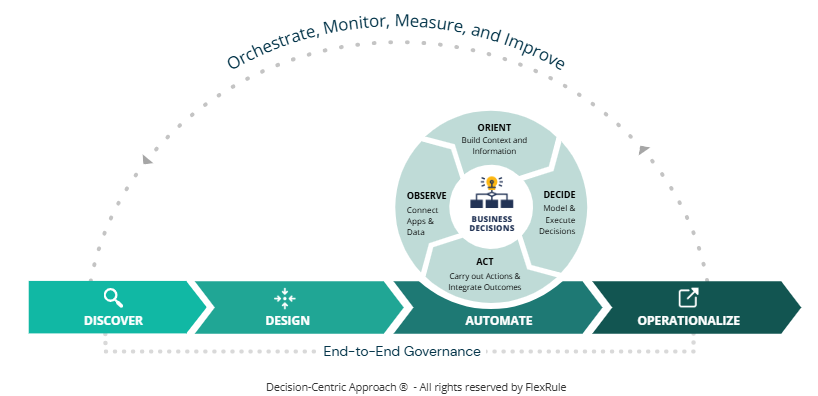
Discover: What Do We Know, Do, and Miss?
Discovery begins by making organizational decision knowledge and behavior visible.
Decision Inventory reveals decisions, business rules, terminology, relationships, and supporting evidence hidden across policies, procedures, and other information assets.
Decision Mining examines operational records to discover how decisions are actually made, exposing accustomed patterns, operational variations (i.e. noise), and inconsistencies.
Together, they reveal two important perspectives: what the organization knows or intends, and what it actually does. But discovery should go beyond of intended and operation source.
Decision Optimization introduces a third perspective: what might have been possible? By replaying historical decisions against optimized alternatives, organizations can estimate missed opportunities and identify where different decision strategies might deliver better outcomes.
Discovery becomes more than understanding existing decisions. It begins revealing their potential business impact.
Design and Automate: Make Decisions Explicit and Executable
Discovering decisions is only the beginning. If you don’t take the discovery to the next phase, is similar to the insight and intelligence that does not reach to action. That itself is a big contributor to the Decision Debt.
In Design, organizations establish decision intent, ownership, authority, information requirements, policies, and constraints. This is done by making the decisions explicit.
In Automate, they make explicit decisions to an executable artifact through various forms of logic such as business rules, analytical models, AI, and other technologies.
Explicit decision models (Decision Model and Notation and Continuous Decision Model) help turn fragmented knowledge into consistent, testable, and governable decisions across time.
However, designing and executing decision logic does not automatically mean the organization benefits. A decision that never influences operations cannot deliver its intended business outcome.
Operationalize: Turn Intelligence into Action and Improvement
Operationalization closes the gap between design, intelligence and business outcomes. If no one acts on decisions and intelligence, nothing changes.
Decision Hub puts decisions in the hands of operational teams. Instead of leaving predictions, recommendations, and decision designs disconnected from everyday work, it brings relevant situations, supporting evidence, and proposed actions into operations.
People can review decisions, exercise judgment, manage exceptions, obtain approvals, and take appropriate action.
The objective is not merely to execute decision models. It is to ensure that decisions become part of the operational activities responsible for delivering business outcomes.
Decision Optimization plays its second critical role here. While historical optimization helps discover missed opportunities, adaptive decision optimization learns from actual outcomes to improve future decisions.
It helps identify the next best offer, discount, rate, intervention, or action while respecting applicable policies, decision authority, and business constraints. The objective is the best admissible action, not simply the highest mathematical reward.
Decision Hub and Decision Optimization therefore address complementary challenges. Decision Hub helps ensure decisions reach operations and can be acted upon. Decision Optimization helps improve the quality of those decisions using evidence from outcomes.
Together, they connect organizational action with continuous learning and improvement by creating experiments and translating learning into incremental and iterative improvements, so the resulting operational evidence flows back into discovery. As a result, new decision patterns can be uncovered, existing designs questioned, and missed opportunities reassessed.
The lifecycle becomes a continuous learning loop rather than a sequence of disconnected projects.
Book a Custom Demo
Final Thoughts
Organizations have spent decades making processes faster, systems smarter, and information more accessible.
Yet we all see and experience, faster processes do not guarantee better decisions. More intelligence does not automatically produce better outcomes. In fact they become the source of more and more decision debt when not driven by explicit decision models.
Reducing Decision Debt requires understanding what we decide, exposing what we have missed, acting on what matters, and continuously improving the results.
The real cost of Decision Debt is not only the decisions that went wrong, but I argue more importantly, is about the value of decisions that were never discovered, never acted upon, or never improved.
Published October 26th, 2026 at 02:29 pm