Continuous Decision Model (CDM) enables decisioning across the decision-making continuum like the nervous system of living, connected, and evolving decisions. Unlike Rule-mining continuous improvements, Process workflow, Case Management, and Sequential Decision Analytics, CDM positions decision-making in a continuum with fuzzy boundaries that learns through feedback loops and deal with uncertainties in real time.
Most organizations claim they use data to make better business decisions.
77% of business stakeholders say the dashboards, models, and reports they get are irrelevant to the decisions they need to make. Instead of driving decision-making behavioral changes, data gets dragged in at the end to justify choices already made. That is confirmation bias at scale.
The latest shiny tools like LLMs, GenAI, and so-called agentic AI have not fixed it either. They just sprinkle more tech on the same broken model.
As we all know by now, data alone does not create success, the decision models driving the data will.
Decision Models to Rescue
Decision Modeling made the first real dent. By modeling decisions explicitly in workflows, we moved past the data-to-action gap. We finally put the decision itself at the center. To make this work, we have to go narrow and deep inside workflows. Model decisions for all those individual workflows and operationalize them.

A sample dynamic decision graph (DDG) part of loan origination workflow.
But there was a catch.
When you model decisions inside a single workflow, you get silos. Each decision works in isolation. They do not see each other. They don’t know their influences on one another. They do not adapt based on what came before or what is coming next.
As a result, it creates what we call a “disconnected decision experience”. Just like the analytics artifacts that felt irrelevant, these siloed decisions also feel irrelevant to the people on the receiving end as their situation and circumstances have changed based on execution of some other decisions.
Continuous Decision Model
The Continuous Decision Model (CDM) is a decision-centric approach that connects individual and silos decisions into a continuous, living network of decisions across time, actors, and contexts. It captures influences of decision models across the decision-making continuum rather than point-in-time snapshot determination. It recalculates the best possible decision in real time, balances immediate context with long-term objectives, and embeds governance and explainability into every stage so decisions remain connected, adaptive, and optimized.
Continuous Decision Model fundamentally changes how decisions are structured, triggered, and optimized over time
Two core ideas power Continuous Decision Model:
- Stage: The specific point in time where the subject is currently located. Whether it’s a customer, a claim, or a case. Stage is a decisionable moment for a subject.
- Best Decision: The most contextually appropriate decision that can be made at a specific stage, for a specific actor, given everything known at that moment.

Additionally with these two, the CDM can account for disruptions, exceptions, overrides, escalations and uncertainties in a dynamic environment where what is going to happen next is not really clear or it is outside of our control.
Best Decision Does Not Mean Short-Term
“Best decision” does not mean short-term optimal. Sometimes the immediate “best” (like pushing another product) destroys the long-term objective (like keeping the customer from churning).
That is why CDM optimizes at two levels:
- Within the stage: What is the best move right now? (Rules, ML, reinforcement learning, constraint programming, etc.)
- Across the journey: What is the best move for the long-term KPI? (Reducing churn, growing revenue, improving retention.)
The power comes from balancing both. Additionally, the best decision, integrates the Next Best Action (NBA) into the model enables that a real-time decisioning principals determine best the next possible action in the moment based on the end-to-end context. This enables the NBA to be applicable in wide ranges of scenario rather than only marketing and customer engagement.
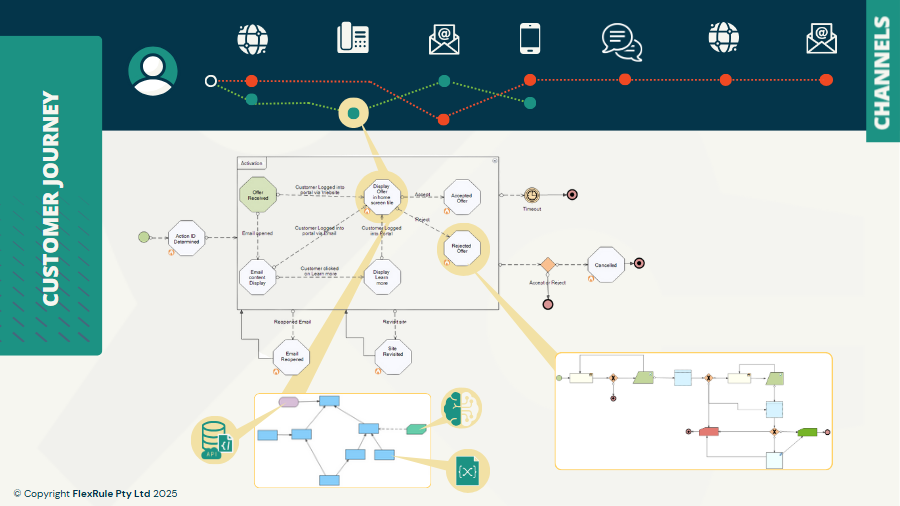
Real-World Example: Customer Engagement
Take financial services. At any point, a customer could be eligible for dozens of offers. Do you push sales? Do you focus on retention? Do you stay quiet?
With CDM:
- The stage defines the moment (say, a call center conversation).
- The best decision is ranked using composite AI techniques. Rules check eligibility, predictive models estimate likelihood of response, reinforcement learning uses feedback from past outcomes.
So instead of giving the call center agent five “eligible” scripts, the Best Decision in CDM gives them the one most likely to work in that moment while still respecting the long-term goal of keeping the customer.
Engines for Digital Twins and Orchestration
In supply chains, Digital Twins act as real-time mirrors of the physical network, replicating factories, warehouses, transport, and demand signals. They provide visibility into what is happening and predicting what might happen, but they do not decide what to do next.
This is where Continuous Decision Models (CDM) come in. CDM transforms insights from Digital Twins into continuous, context-aware decisions such as rerouting shipments, reprioritizing orders, or adjusting production schedules. As the Digital Twin updates, CDM recalibrates choices in a persistent loop, ensuring the supply chain remains observable, predictable, adaptive, governed, and optimized in real time.
Supply chain conditions change constantly: new data streams in, forecasts shift, disruptions emerge, and priorities evolve. A single response quickly becomes outdated. CDM ensures decisions are sequential and continuous, recalculated in context each time the Digital Twin evolves. This keeps actions relevant, adaptive, and aligned with objectives, turning Digital Twins from passive mirrors into engines of ongoing, governed, and explainable decision-making.
Beyond Traditional Decision Making
CDM moves beyond the old notion of “decision making” and reframes it as the relationships between humans and agents operating inside a system.
With a multi-actor input, it models a network of interaction that holds together, even if its boundaries are fuzzy. An actor is anything that acts in the system: humans and individuals, groups, processes, AI agents etc.
Most decisions hit the issue of disconnected decision experience over time because they lack end-to-end context. They do not “know” their influence on each other, cannot adapt to past decisions or future paths, and are rarely optimized. This absence of connection creates a disconnected decision experience.
CDM flips this. It defines goals across different phases of a journey — whether that is a product lifecycle, a customer lifecycle, or a supply chain. It creates a continuum of decision types:
- Support and Augmentation: observe and model the current reality with agents working toward explicit goals.
- Automation and Orchestration: agents function as goal-seeking entities, identifying future goals and strategizing optimal paths.
Contrast to Continuous Decision Model (CDM)
The Continuous Decision Model is about breaking those silos. Think of it as stitching decisions together into a living, connected flow that runs across time, actors, and has the end-to-end context.
It is not process orchestration such as BPMN or workflow. The end-to-end orchestration is useful when we know exactly what the next step might be. The orchestration is based on predefined steps, and it is prescriptive. If the next step is not clear you cannot use a process model.
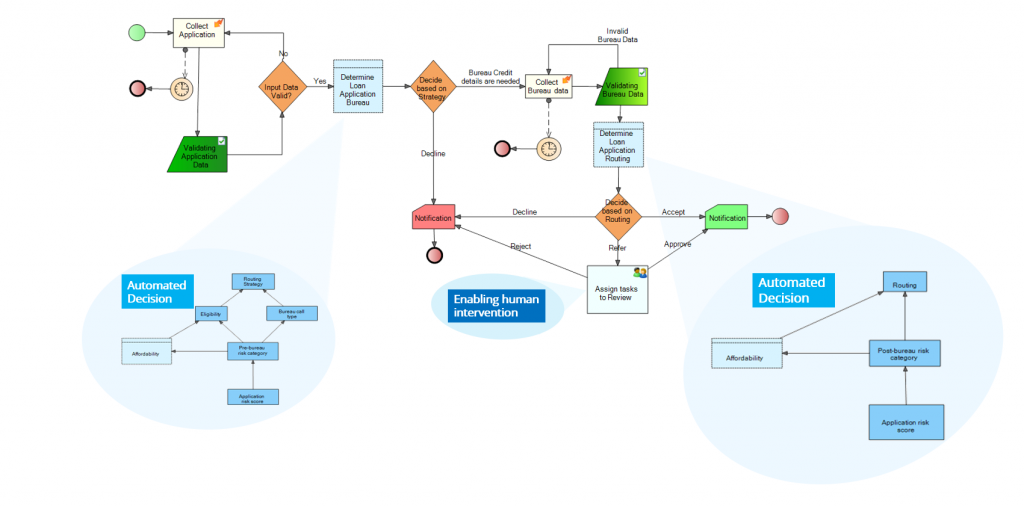
A sample workflow from loan origination example that has decision models integrated for straight-through processing.
It is not case management (CMMN) as such. Case management works best when it is about handling case one step at a time. Case management is more suited to complex cases where dynamic action, ad hoc decision making based on knowledge worker is required in process execution.
It is not continuous improvement approaches such as rule mining or retrospective analytics. Those techniques are backward-looking and batch-oriented, discovering patterns from past data and updating rules incrementally after the fact. CDM, by contrast, is forward-looking and runtime-driven, recalculating the best possible decision continuously and embedding governance and explainability into every step.
It is not Sequential Decision Analytics (SDA) as a mathematical formulation of actions and states. In classic sequential decision-making in RL/MDPs, it is often episodic where episodes reset and the focus is on choosing an action.
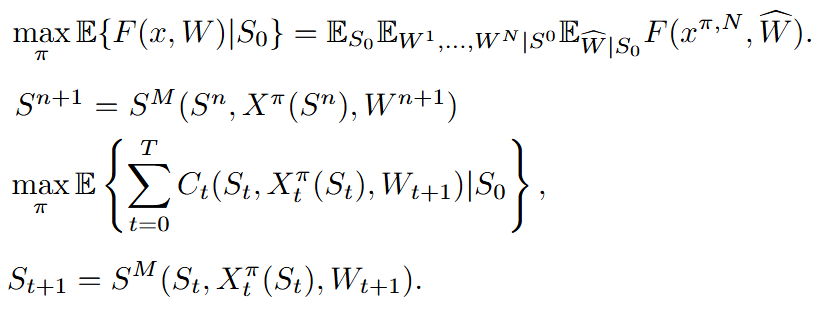
A stochastic control (or Markov Decision Process) formulation that defines how to choose a policy 𝜋 to maximize the expected cumulative reward under uncertainty.
Unlike SDA, CDM is continuous and open-ended, so decisions do not reset but evolve in a persistent loop, always ready to respond to new events.
CDM focuses on making the “best decision” explicitly modelled and optimized while staying aligned with business objectives such as revenue, cost, and risk. Decisions evolve through time across the decision-making continuum, using multiple techniques of decision modeling and execution to ensure at any stage the best decisions are in place knowing the end-to-end context to elevate the quality of decisions with close frequent feedback loops.
Adapt to Change by Feedback
CDM opens the door to focus not only on automation but on the quality of decisions themselves. At the heart of this is an integrated feedback loop where every outcome informs the next decision. Once the feedback is collected it learns and adapts which outcomes performing better in the short-term (best decisions) or long-term (journey).
- Probability and risk-adjusted alternatives: Decisions are not made blindly but evaluated against uncertainty and risk.
- Explainability of why a decision was made: Each decision step is traceable, governed, and transparent.
- Continuous learning from outcomes: Feedback from real-world results recalibrates future decisions in context.
- Decision quality scoring: Outcomes are assessed against objectives and KPIs, reducing ambiguity and reinforcing alignment.
It is not simply about making faster choices. It is about ensuring that every decision is the best it can be, continuously refined and aligned with organizational goals through a closed feedback loop.
Book a Custom Demo
Nervous System of Decisions
CDM positions organizational decisions across the decision-making continuum as the nervous system of living, connected and evolving decisions. Organizations no longer operate with clear boundaries, predictable flows, or controllable feedback loops. They face uncertainty, fuzzy boundaries that cannot be managed with dashboards, static rules or prescribed processes. CDM equips organizations with continuous, adaptive knowledge and end-to-end context, making decisions connected, contextual, adaptive, and optimized.
Customers do not move in straight lines. Processes are not predictable. If you want decisions that are relevant, contextual, and optimized, you need more than siloed decision models in isolated workflows or AI buzzwords. You need Continuous Decisions — the nervous system of organizational decision-making.
Last updated February 17th, 2026 at 11:56 am Published September 29th, 2025 at 10:54 am