Adaptive Decision Optimization: Decisions That Learn, Evolve, and Improve over time.
Enterprises are obsessed with letting LLMs and Generative AI do more work for them. Write faster. Summarize faster. Search faster. Respond faster.
That improves productivity. But it does not automatically improve the operational and tactical decisions the business makes every day.
LLMs have no knowledge of decisions. Decisions are hidden and implicit in a black box. They do not define, in a governed and traceable way:
- What objective is being optimized
- What constraints must be respected
- Which action was selected
- What outcome followed
- What feedback should improve the next decision
In contrast, optimization (operations research) and business rules are static and fixated on values, and they rely on the predictability of the environments in which they operate. Traditional machine learning (regression, classification, forecasting) relies on batch updates based on past history and data collection.
Neither of these solutions accounts for the reality of the world: messy and uncertain situations unfolding over time.
That is what Adaptive Decision Optimization accounts for.
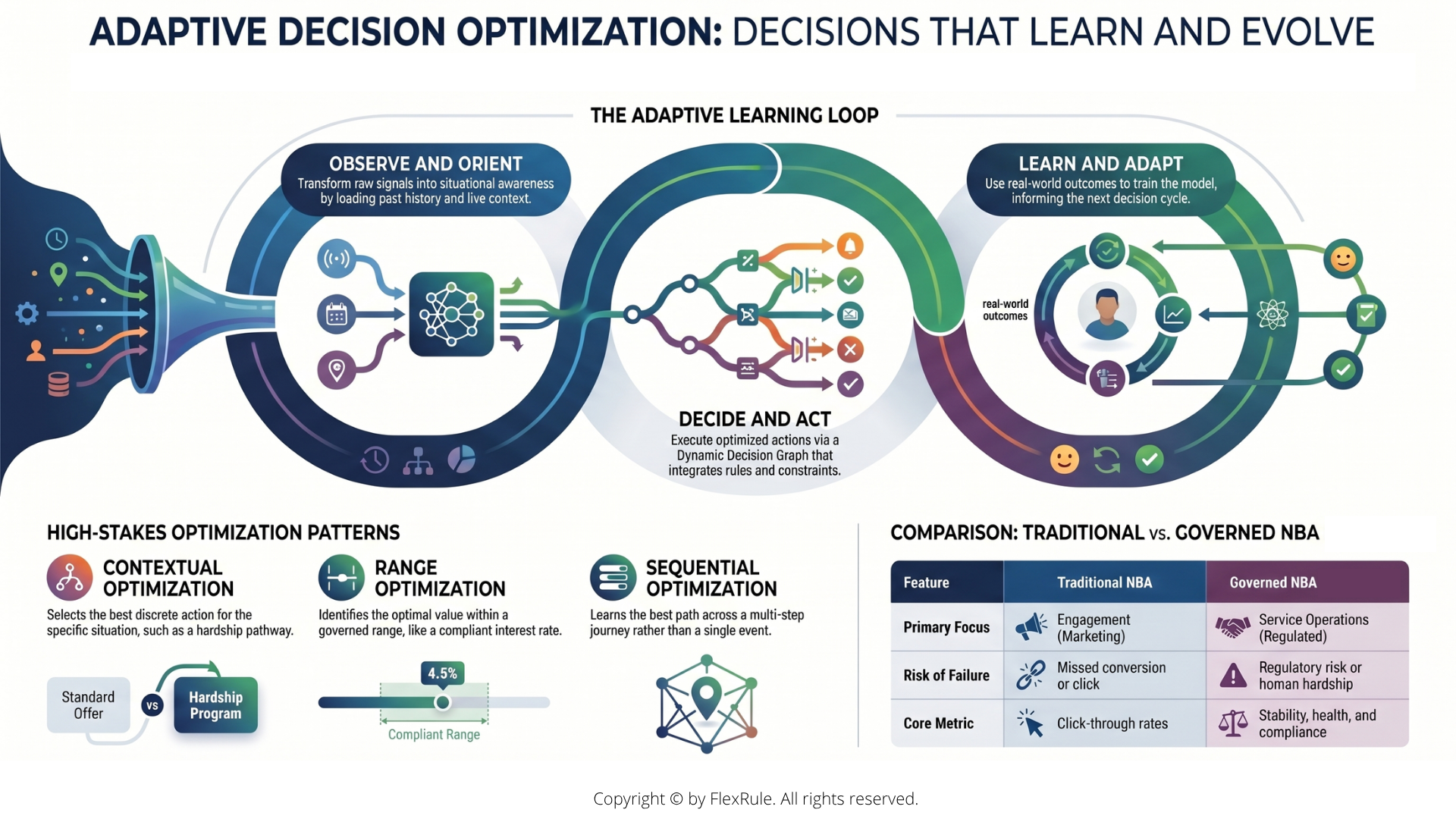
Traditional NBA optimization in marketing operations was built for the engagement layer. The cost of a wrong optimization is a missed conversion, a lower click rate, a less relevant offer. Meaningful, but recoverable.
Adaptive Decision Optimization extends optimization into a different class of decisions entirely. In regulated service operations, the decisions being optimized are not about which message to send. They are about which hardship pathway to offer to a customer who cannot pay their mortgage. Which clinical intervention to prioritize for a patient whose condition is deteriorating. Which collections approach to take with a customer showing signs of vulnerability. Which guidance to provide a retiree whose financial future depends on the recommendation they receive today.
In these decisions, the cost of optimizing poorly is not a missed conversion. It is a material impact on a person's financial stability, health, or quality of life. The loss is not measured in click-through rates. It is measured in hardship prolonged, harm caused, or an opportunity to help that was missed.
This is why Adaptive Decision Optimization is a critical component of Governed NBA. It brings the same continuous learning capability that improved marketing NBA into the territory where getting the decision right matters most. Not just optimizing for the next best offer. Optimizing for the next best governed action, within regulatory obligation, for decisions where the stakes are human.
In regulated service operations, this gap is not just a performance problem. Ungoverned optimization in a regulated decision context is a governance and regulatory risk.
The Problems Adaptive Decision Optimization Solves
Decisions fail in three distinct ways. Each failure has a different cause and requires a different response. Adaptive Decision Optimization is built to address all three.
Irrelevance: Does This Decision Fit the Current Situation?
Irrelevance is about making the unrelated or alienated decision for the current context. A decision is only relevant when it reflects the situation in front of it: the customer, transaction, risk, constraint, capacity, timing, channel, or market condition at that moment.
Adaptive Decision Optimization improves relevance by using the available context to select the best action, value, or path for the situation at hand. It is not about whether the model has become outdated over time. It is about whether the decision fits the current cases, and which is most relevant when multiple competing options are available.
Drift: Has the Decision Fallen Behind Reality?
Drift is the gap that appears when the world moves, but the decision logic does not move with it. A decision may have been correct when the rules, thresholds, model, or optimization strategy were created. Markets change. Customer behavior changes. Cost structures change. Risks change. Operational conditions change.
Over time, the decision becomes less effective because it is still based on old thresholds, values, and assumptions. Adaptive Decision Optimization reduces drift by continuously learning from outcomes and adjusting the optimization logic as reality changes.
Uncertainty: Can the Decision Adapt When the Answer Was Not Knowable in Advance?
Uncertainty is about handling situations that cannot be fully predicted or predefined in advance. Rules can define guardrails. They can specify what is allowed, what is prohibited, what must be checked, and what constraints must be respected. But rules cannot anticipate every nuance, rare event, emerging pattern, or new combination of conditions.
Adaptive Decision Optimization handles uncertainty by learning from new outcomes when there is no complete predefined answer. It does not replace the rules. It works inside the rules to adapt where the best answer is not known upfront.
Relevance asks: Does this decision fit the current situation?
Drift asks: Has the decision fallen behind reality over time?
Uncertainty asks: Can the decision adapt when the answer was not knowable in advance?
Adaptive Decision Optimization is built to answer yes to all three.
The organization whose decisions interpret context faster and more accurately than competitors will consistently make better offers, create more value, deliver better experiences, and win more opportunities.
How It Works: The Adaptive Loop
Adaptive Decision Optimization operates through a closed loop grounded in the decision cycle OODA loop: Observe, Orient, Decide, Act.
Observe. The Continuous Decision Model receives the raw signal. A customer event, a transaction, a stage transition, an external trigger. Unprocessed. No meaning yet.
Orient. LiveContext is assembled based on the situation to make sense of the raw signal. It establishes decision memory by lazily loading past history and journey context from multiple data sources, along with any additional data needed on demand. Raw signals become situational awareness context.
Decide. The explicit Dynamic Decision Graph (DDG) integrates rules, optimizes using relevant context, executes decisions, and creates values that are optimized for the situation based on what Adaptive Decision Optimizations has learned so far. Business rules, constraints, machine learning, and the optimizer all run within the graph as part of a unified execution boundary.
Act. The decision outcomes are carried out. Results are reflected back into systems and processes. The customer receives the offer. The shipment is rerouted. The claim is triaged. The world changes.
Learn and Adapt. The optimizer observes what happened as a result of Act. The world's response to the action taken is what trains the model. The next Orient and Decide cycle is better informed as a result.
These stages are not linear; they are spanned and orchestrated across time via the Continuous Decision Model, which plays a critical role by providing the foundation for Adaptive Decision Optimization to stand up.
Three Decision Optimization Patterns
In simple terms:
Contextual Optimization selects the best action for the current situation.
Range Optimization finds the best value within a continuous range.
Sequential Optimization learns the best path across a journey.
Each strategy is expressed as a decision unit within the execution boundary, and feedback will be collected whenever it becomes available, either immediately or in the future.
Contextual Optimization: Choosing the Best Choice
When the goal is to select the best choice (proposition, action, etc.) from a set of discrete options, contextual optimization learns which choice performs best for each context. It builds a rich understanding of which choices work for which contexts and updates that understanding with every interaction.
In financial services: A contact center agent speaks with a customer approaching retirement who holds a regulated superannuation fund. Governed NBA evaluates the customer's financial profile, disclosed circumstances, and regulatory constraints to determine the most appropriate guidance pathway. The system learns which consultation approach produces better retirement outcomes for customers in similar situations, without stepping outside the obligations that govern what the organization is permitted to recommend.
In marketing: A marketing team runs Next Best Action across hundreds of thousands of customers. The Continuous Decision Model continuously tracks each customer's journey state. Every email opened, every offer ignored, every support call made recalibrates the next decision. Over time, the system stops wasting time on actions that do not convert and concentrates effort where the signal is strongest. Beyond the engagement layer, the same logic governs operational decisions, including collections strategy, hardship treatment, and vulnerability protocols, where the cost of a wrong action is not a missed conversion but a regulatory exposure.
Range Optimization: Finding the Best Value
When the goal is to find the optimal value within a continuous range, range optimization intelligently searches the solution space. It narrows in on the optimal value without brute-force evaluation. Because it operates online, it adapts as the reward landscape shifts without retraining.
In financial services: A loan interest rate must stay between 5% and 12% based on compliance and risk policies. Adaptive Decision Optimization goes further by continuously learning which value inside that range maximizes the chance of closing the loan while still meeting profitability and risk objectives for a specific type of business or client. In regulated lending, the governance boundary ensures the optimized value never breaches responsible lending obligations or affordability thresholds. Adaptive Decision Optimization finds the best value inside the governed range, not around it.
In financial services collections: Regulatory policy defines the acceptable range of repayment arrangements available to customers in hardship. Adaptive Decision Optimization continuously learns which repayment value inside that range maximizes successful resolution while minimizing customer harm, adapting as customer profiles, economic conditions, and regulatory guidance evolve.
Pricing and discount: Traditional rules define the acceptable discount range for an airline upgrade offer. Adaptive Decision Optimization continuously learns which offer value maximizes upgrade conversion based on customer behavior, flight occupancy, timing, and demand.
In supply chain: Traditional optimization (OR) and forecasting define acceptable inventory reorder ranges based on predicted demand, supplier lead times, and operational constraints. Adaptive Decision Optimization goes further by continuously learning which reorder quantity inside that range produces the best real-world outcome as demand patterns, delays, seasonality, and supply chain conditions change over time.
Sequential Optimization: Choosing the Best Path
When decisions unfold across time, sequential optimization learns how to maximize outcomes across the entire lifecycle. The best decision at step one is the one that starts the best journey.
In regulated customer operations: A customer enters a hardship support pathway with their bank. The Continuous Decision Model tracks every interaction across the journey. What was offered, what was declined, what the customer disclosed, and what changed between interactions. Sequential optimization learns which sequence of governed actions across the hardship journey produces the best outcome for customers in similar situations, reducing harm, meeting regulatory obligation, and improving resolution rates simultaneously. Next Best Action is not a campaign decision in this context. It is a continuous, governed, journey-aware decision that evolves with every signal the customer sends.
In supply chain: The Continuous Decision Model runs in a persistent loop, continuously recalibrating decisions as the Digital Twin evolves, knowing how the future unfolds. Sequential optimization learns which sequence of decisions minimizes end-to-end cost and maximizes service levels, adapting to disruptions and shifting demand in real time.
The Continuous Decision Model: The Backbone of Adaptive Decision Optimization
The Continuous Decision Model (CDM) serves as the backbone for Adaptive Decision Optimization. It provides a structured memory of past decisions, a live contextual understanding of the present, and a map of potential future paths. By orchestrating state, context, and feedback, CDM enables decisions to evolve over time. It is the foundation that allows optimization to not only act in the moment but to adapt across time.
The Continuous Decision Model enables decisions to unfold over time and ensures along the execution boundary extended throughout time the feedback for the outcomes is collected. This is an essential step to make Adaptive Decision Optimization perform.
By laying out the potential future paths, e.g. stages in a customer journey or steps in a process, CDM allows optimization to look forward, not just react. So it enables optimization across the path of how the future unfolds. CDM enables trajectory optimization because it does not treat decisions as isolated events. It keeps the state of the journey: what has already happened, what stage the case, customer, claim, transaction, or process is currently in, and what future paths may still unfold.
This gives Adaptive Decision Optimization the structure it needs to optimize beyond the immediate next choice. The optimizer can evaluate whether a decision is good not only for the current moment, but for the direction it creates across the journey. Through Best Decision linking, CDM activates the right optimization point at the right stage, while Dynamic Decision Graph (DDG) executes the decision with the full context, rules, constraints, and learned feedback available. This is how optimization shifts from choosing the best action now to improving the whole decision trajectory over time.
Built for Business and Technical Teams
The real barrier to decision optimization is often organizational, not conceptual. Optimization requires specialized skills to build and maintain. It remains the domain of a small team of specialists, disconnected from the business practitioners who best understand the decision context.
Adaptive Decision Optimization removes that barrier through two entry points.
Decision Knowledge is the no-code and low-code layer for business users, operations teams, and domain experts. Through Decision Knowledge, practitioners model decisions, configure optimization constraints, simulate scenarios, and train the optimizer without writing a single line of code. A pricing manager, a marketing operations lead, or a supply chain planner can bring optimization into their decision model directly, without making the data science team a bottleneck.
DecisionLang and the Optimization Module is the code-first layer for decision engineers and data scientists. Through DecisionLang, practitioners have full programmatic control. They define reward functions, tune exploration strategies, build training pipelines, and simulate optimization behavior against historical or synthetic data.
Both paths produce the same result. Optimization lives inside the Dynamic Decision Graph, which, by the way, is based on the open standard for decision modeling (Decision Model and Notation, DMN with Conformance Level 3). It is governed by the same rules, visible to the same audit trail, and continuously learning from the same feedback loop.
Book a Custom Demo
Final Thoughts
Large language models and generative AI, although effective for productivity, have no explicit decision model. The decisions they influence are hidden, ungoverned, and impossible to optimize in any traceable or systematic way.
Explicit decision models change how organizations approach decision-making entirely. The decision modeling standard like Decision Model and Notation and advanced techniques like the Dynamic Decision Graph give organizations a governed, transparent structure for their operational and tactical decisions.
This structure is what gets activated via the Continuous Decision Model that provides the Best Decision opportunity using Adaptive Decision Optimization. When the decision is explicit, every element can be defined, measured, and improved: the objective, the constraints, the action selected, the outcome observed, and the feedback that improves the next decision. Adaptive Decision Optimization works inside that structure, over time, improving contextual choices, range value options, and sequential influences of decisions over time.
This is especially consequential in regulated industries, where Governed NBA applies Adaptive Decision Optimization to the decisions that carry regulatory obligations, including hardship treatment, claims routing, collections strategy, and customer remediation, continuously improving outcomes within the governance boundary.
Adaptive Decision Optimization continuously learns and improves with every outcome.
Read More


Last updated May 19th, 2026 at 02:55 pm Published May 11th, 2026 at 01:41 pm