Decision Intelligence is well positioned to not only address the Last-Mile Gap of data and analytics but also, enable organizations to go from insights to outcomes. However, this transition of insight-to-action and action-to-outcome has a very specific perquisite and only then that can happen.
In the data-driven world organizations operate in, they chase vanity metrics. The data-driven metrics. The promise of turning information into action and then into meaningful outcomes is not going to happen with the data-driven mindset and approach.
Let's face the reality: Actionable Insights ≠ Decisions
Organizations such as insurance and financial services made significant progress from data to insight, and many technologies today claim to help cross the chasm from insight-to-action. But their underlying assumptions are wrong.
Reality is Actionable Insight is not Decision. To close the gap between insight and action, Decision should be positioned as the core asset of organizations.
Otherwise, the result of all efforts will be translated to some shape and form of data-driven assets such as Machine Learning models, Dashboard and Reports which cannot influence organization behavior change.
The Last-Mile Problem: Why BI Isn’t Enough
Analytics platforms have long promised to support better decisions by offering actionable insights leveraging prescriptive, predictive, or diagnostic analytics. However, insights do not inherently drive business change.
At least not in a good way. Stats show 65% of time, we use insight to justify the already-made decisions. So not only the BI insights will not derive a positive change but also amplify the human confirmation bias at scale.
Adds the noise problem on top of the human confirmation bias and we will have a systematic machine that makes inconsistent and bad decisions at scale using data-driven approach.
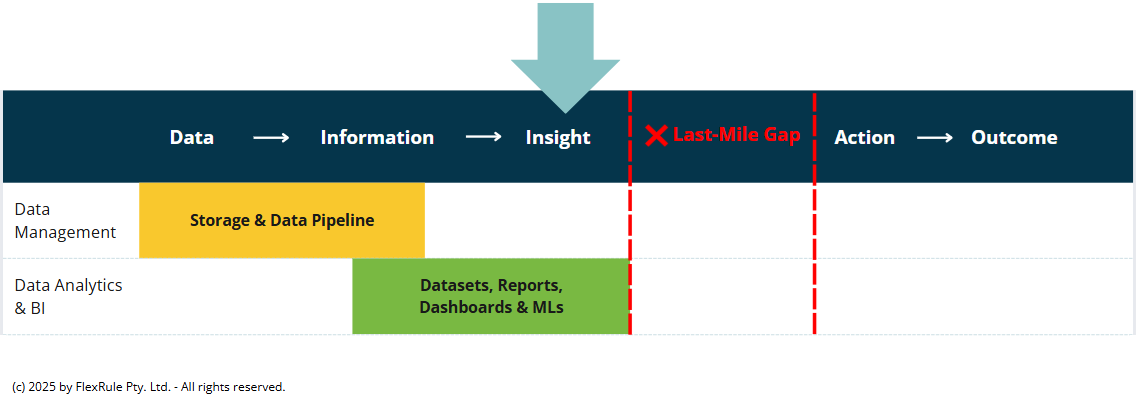
The last mile of analytics is the gap between Insight to Action. And the missing link is Decisions.
Decision Intelligence: Bridging the Gaps by focusing on Decisions
Decision Intelligence doesn’t stop at surfacing insights. In fact, Decision Intelligence is upstream of BI. It means that it consumes the datasets, information and sometimes insight to execute explicitly modeled decisions.
The reason Decision Intelligence can bridge the gap is its core emphasis and foundation based on decision modeling. explicitly modeling decisions using logic, data, and context to guide and automate toward the business outcomes.
The option standard for modeling decisions i.e. Decision Model and Notation (DMN) at Conformance Level 3 enables clarity and transparency of the decision models. These decision models do many things such as eligibility, classification, or determination and more based by applying decision logic within a specific context given an input.
By putting the explicitly modeled decisions and proactively operationalizing them Decision Intelligence (DI) closes the gap between insight and action.
But Outcomes Still Vary…
Not every action leads to the same result every time. Even if determining the action is deterministic, and result of the action are the same, but impact of them may not be the same.
An action taken today may not have the same impact tomorrow, depending on changing contexts, customer behavior, market conditions, or policy changes.
That’s why closing the decision-to-action gap isn’t enough. Decision Intelligence must now evolve to close the insight-to-outcome loop. This is ensured by associating the PKIs and metrics that matter for the decision, not just executing the actions but also measuring and monitoring the impacts of the actions.
Continuous Improvements and Feedback
The future of Decision Intelligence is not static rule sets or rigid ML pipelines. It’s about dynamic, real-time systems that adapt based on feedback, context, and performance.
Once the action has created the outcome, there is no guarantee that it has a positive impact on the business. Therefore, the DI must collect feedback from humans, environments, systems, etc., capture them and feed them back in and readjust decisions, reprioritize eligibility, offers and actions. In short, DI must adapt to the changing environment.
This is where Continuous Decisions come into play. In an environment where machines and intelligent agents are now users as well as humans the insights are not for visualization anymore. They are feedback signals that fuel a decision models, tuning decisions and their downstream actions in real-time and it adapts based on its surroundings, policies and impact of the enacted actions.
This feedback loop ensures that the decisions being made remain aligned with evolving business goals, regulations, and customer expectations and experience. Instead of merely automating decisions, organizations must now optimize them for better outcomes.
Book a Custom Demo
Adaptive Decisions: Why Static Logic No Longer Works
In a stable world, static rules and predefined models might suffice. But business today operates in a high-velocity, context-sensitive and changing environment where yesterday’s logic often fails to deliver tomorrow’s results. This is where adaptive decisions become essential.
Adaptive decisions piggyback on the feedback look and leveraging AI techniques such as Reinforcement Learning (RL) to give models rewards based on the impact of the outcomes.
This AI-Powered decision engine enables the decision models to be more situation-aware based on what works and what does not based on the individual context they interact with.
Rather than relying solely on retraining machine learning models offline or redeploying logic manually, or static rules, adaptive decisions live within a continuous feedback loop:
- Observe: Monitor decision performance and contextual shifts.
- Adjust: Use feedback to refine decision paths, thresholds and readjust priorities of eligibility.
- Re-Act: Apply the new decision logic in real time.
This loop is not hypothetical. It’s enabled by architectures that:
- Track decision outcomes and business impact metrics,
- Connect feedback from real-world execution (e.g., customer response, fraud rate, compliance flags),
- Trigger rule adjustments or retraining based on performance variance and rewards
- And support real-time event-driven orchestration of the next-best-actions
Whether it's pricing, claim approvals, personalization, or risk assessments the adaptive decisions allow systems to learn and evolve, not just automate. This level of agility is what sets modern DI platforms apart from legacy rule engines or static ML workflows.

With adaptive approach in decision models Dynamic Decision Graph (DDG) and Continuous Decision Model (CDM) the Decision Intelligence moves from automation to optimization enabling organizations to make optimized, customer-centric and situation-aware decisions.
The Future of Decision Intelligence is Here Today
In many large Insurance and Financial Services companies, the establishment of a BI Center of Excellence (CoE) is seen as a milestone of maturity in the data-driven mindset. But it often reveals something deeper that Organization have stuck in the “last mile of analytics“.
Despite tens and hundreds of thousands of reports and dashboards data and analytics and data-driven approach has failed:
- Decisions are inconsistent.
- Actions are delayed.
- Outcomes are lagging.
- Machine Learning models are lacking business values.
Decision Intelligence (DI) is well positioned to address the above issues in the data and analytics and data-driven mindset.
More importantly, DI does not only close the last-mile gap of data and analytics, but also, it does close the feedback loop and make decision models adaptive. The good news is that the Future of Decision Intelligence is here today with AI-Powered Adaptive Decisioning and Continuous Decision model that enables continuous learning and improvements at real time from feedback and external environments signals and events.
Check out our platform page for more detail.
Published April 24th, 2025 at 10:38 am