Traditional orchestration is static and cannot deal with dynamic and changing environment to orchestrate decisions across different processes, systems and groups. The process-and-flow-like orchestration is not adaptive and is fragile to be able to automate decision scenarios that evolve over extended period of time to deal with uncertainties and unknown.
Orchestration at its core tries to bring together all pieces of a scenario for execution – steps toward creating an outcome. This is why many orchestration capabilities are like process models; in fact, process models and engines are used most of the time to orchestrate. Let's not forget that process models involve coordinating between people, systems, data, and tasks to ensure things go according to a predefined plan. It functions like a workflow where actors (i.e., humans) are assigned the right tasks with the right tools and data at the right time to act upon them.
The traditional approach to orchestration is prescriptive and does not work in any dynamic setting in which organizations operate today. It relies on the fact that we know what the next step is. That's why traditional orchestration cannot bring together decisions across a business environment to create outcomes where business decisions are discrete and spread across different timelines, processes, systems, and places. Therefore, connecting them via a prescriptive approach is not possible simply because the next steps toward the next decisions are unknown in the future and outside the context of the orchestration (i.e., process) model to control.
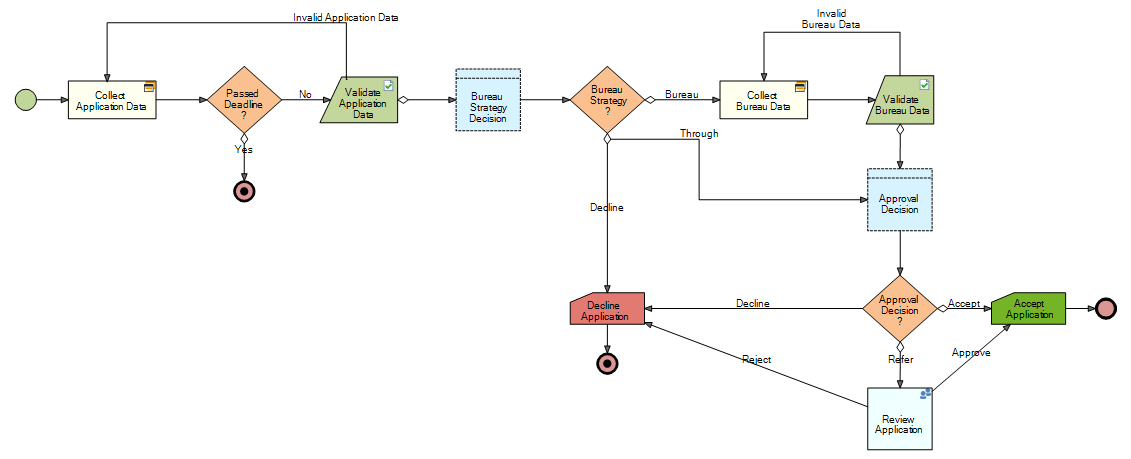
The need for any orchestration to precisely map out how things should be done and bring together different pieces of a workflow becomes very fragile in any dynamic environment where things are changing frequently. Therefore, an orchestration that prescribes the steps, such as process (BPMN, Flow, etc.) techniques, for a dynamic environment is very naive.
The best option is techniques such as CMMN, which is mostly for dynamic workflows based on cases. Although case management models like CMMN are very complex and have an unusual notation for many industry professionals, they can retrofit into an event-driven design. This event that does not cover the need for decision orchestration
- Lacks detailed behavioral and interruption modeling
- Focus is on the case logic and relation between discretionary tasks
- Cannot manage state based on conditions transitions, entry and exit criteria and decisions
In a decisioning scenario, the involved decisions may happen in an unordered sequence, not in the same session, but also at different times and with delays and interruptions. As a result, traditional orchestration falls short in orchestrating today's complex decisioning scenarios that involve multiple related but not prescribed, step-by-step sets of decisions.
Continuous Decision Model
Hence, based on what we discussed, a decision has its own subcomponents, but as a whole, is discrete. Bringing together the discrete decisions to create an outcome requires a Continuous Decision Model or CDM.
A Continuous Decision Model represents an ongoing range of possible decisions that evolve over time, where responses and interruptions influenced by external and internal factors will continuously adjust the next decision within a defined continuum.

The Continuous Decision Model presents the continuum of decisions until specific outcomes are achieved, or a boundary of the continuum is interrupted.
This type of orchestration for decisions enables putting together manual and automated decisions to define a continuum to create an outcome. This model is grounded in a Decision-Centric Approach®, where the decisions are the core pieces of organizations, yet discrete across processes and systems.
One of the key use cases for the Continuous Decision Model (CDM) is where external circumstances and conditions are evolving and therefore, a prescribed approach leads to decision drift e.g. customer engagement and personalization – realizing the customer journey. As we know, a customer's journey is not linear and is unpredictable, no matter how much information we know about them, and it's based on a series of decisions the customer or client makes.
Therefore, a journey implementation, such as marketing campaign, patient journey, student journey, etc., are a perfect fit for the Continuous Decision Model.
Book a Custom Demo
Conclusion
Prescribed orchestration, such as flows and processes, is prescriptive. They are very difficult to adapt to change. Most importantly, they cannot deal with the unknown and complexity arising from uncertainties and external events.
Traditional orchestration, such as BPMN, processes, and workflows, rely on predefined, rigid sequences and steps (a prescriptive approach). In modern organizations, where business decisions are distributed across various timelines, processes, systems, and locations, the traditional orchestration approach cannot effectively connect these distributed decisions to drive desired outcomes.
The Continuous Decision Model or CDM in short, gives organizations the ability to define a continuum for a set of decisions and, re-evaluate them, and adjust the next decisions based on the engagement they have with clients, partners, or based on internal or external events. Therefore, the Continuous Decision Model (CDM) is an effective modeling technique that dynamically adapts to evolving decisions, conditions, and circumstances which integrates both manual and automated decisions to drive outcomes in real time across processes and systems at scale.
Last updated January 12th, 2026 at 12:16 pm Published January 17th, 2025 at 12:37 pm