An organization’s most important asset is its knowledge, to be more precise their domain knowledge. This knowledge is generally embedded into processes, systems, and most notably in the heads of domain experts. Many organizations have tried to document the processes and procedures in tools such as Microsoft Word, Visio, or some online tools such as Confluence and wiki sites. For calculations, managing data, and creating charts, they use Spreadsheets such as Excel and Google sheets.
These documents representing the knowledge of the organization require a tremendous effort to maintain and the on top of it even more to code and integrate them into processes and systems which will never finish. As an organization matures and the environments they operate in changes based on demand for new requirements, regulatory and compliance needs, market segmentation and etc., these documents require constant updates and revisions to the point that they are often always stale and outdated.
The question is if there is a better way to capture knowledge in organizations?
Capturing Knowledge is Mission Critical!
Organization knowledge comes in different shapes and forms:

Let’s have a look at a couple of examples. For instance, the decision-making process of drug experiments in labs. Based on specific criteria, some results are more successful than others. It is hard to detail the process, criteria, and inputs in PowerPoints and Words.
Another example is underwriting in insurance. Based on a rule book that guides the underwriter on what to do and how to evaluate certain conditions.
Or, for example, the decisions of a domain expert in labs to configure medical imaging equipment that can provide Scans, MRI, X-rays, and so on. For instance, Image morality scan configuration is based on many parameters for CT machines.
Or, another example might be disk-driven scoring, for instance bushfire rating, insurance rating, credit decisioning and more.
And last but not least, when procedures should strictly follow regulations. For instance, the approval and decline of applicants for a personal or business loan are based on many parameters that should be auditable and explainable.
AI Is Not the Same as Capturing Domain Knowledge
The purpose of capturing knowledge is to make it explicit, transparent, and enforceable at the right time. This ensures institutional knowledge is not lost or buried in the heads of domain experts. Using AI or LLMs is not the same as capturing organizational knowledge.
LLMs can generate and assist, but they do not inherently provide visibility and transparency, and they do not work based on any explicit logic. By all means, they are black boxes. They do not preserve the institutional knowledge behind decisions such as rules, policies, exceptions, governance, and operational logic.
Using AI as a replacement simply moves the knowledge from domain experts head to a black box. It does not solve the problem that knowledge capturing is intended to solve.
However, after the knowledge is captured explicitly, organizations can operationalize it and integrate it with AI using models such as Dynamic Decision Graphs (DDG). This technique is called Composite AI, which integrates rules, procedures, and policies (domain knowledge) with AI models. It is also known as Neuro-Symbolic AI.
The Challenge
Now imagine what happens if, for any reason, the core team or staff are not in the company anymore. Will the company be able to continue the operation without interruption? When new staffs are on board, can they ensure the same quality of operation at least as efficiently and effectively as the former team?
More importantly, how can you operationalize that knowledge and integrate it into your systems, processes and AI reliably?
We built a solution that solves this particular problem. We allow our customers to capture the organization's domain knowledge in different areas and departments. This knowledge might be based on various kinds of models, e.g., processes and workflows, business decisions, business rules, calculations, fact concepts, and so on…
But, they all should be around the business decisions the team make every day using that knowledge. Why do you need that knowledge become explicit, transparent and enforceable? To be used consistently across daily operation when decisions are made.
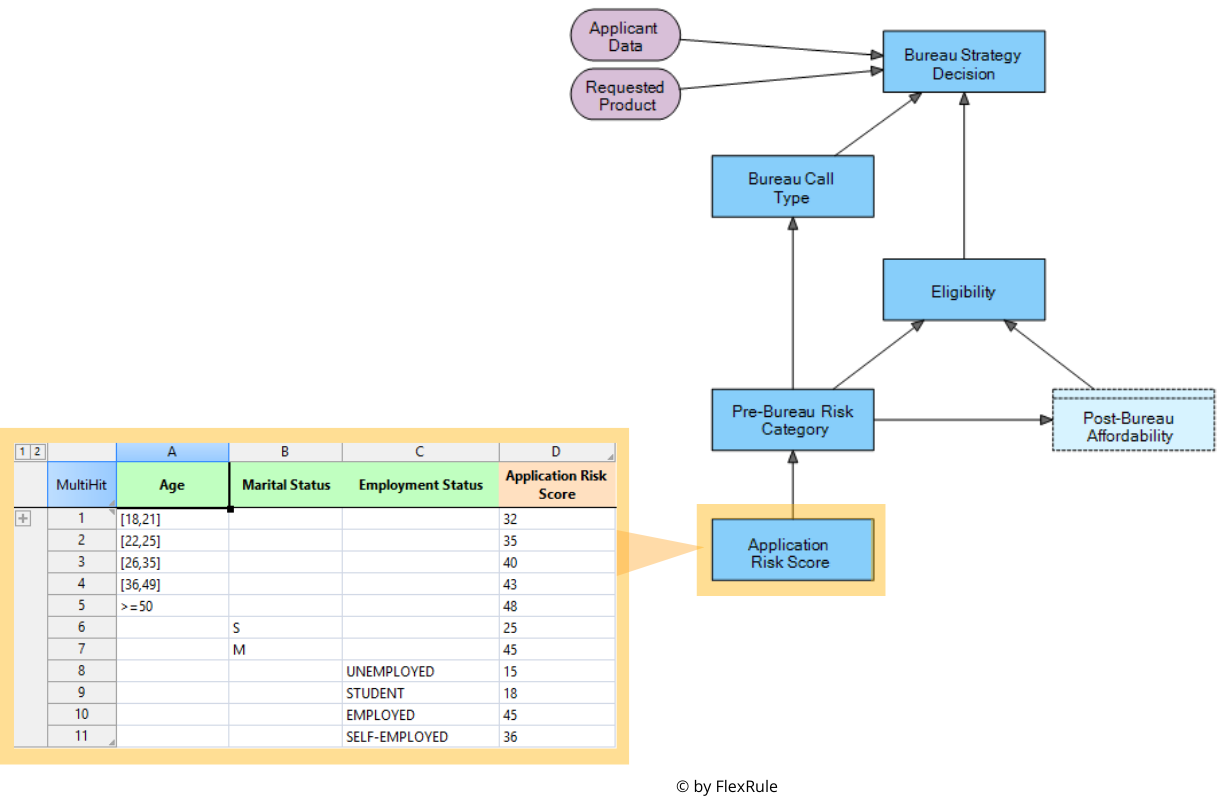
An example of Risk-driven scoring that contributes to higher level of decision
The promise is that capturing the knowledge should not need any programming or technical skills; it is as simple as using Visio, Excel, and other tools that domain experts and business analysts generally use daily.
Not Just a Visual Representation
Once the knowledge is captured, it is very different from the traditional documentations in Visio, Word, Confluence, Excel and AI guesses through data. They are the explicit and live specification of institutional domain knowledge, documented and captured by operations and subject matter expert (SMEs) teams. By adding some trivial details, they will be operationalized. It means you can test, simulate, deploy and execute them without any coding, handover to IT and software development team can focus on more strategic priorities not hard-coding domain knowledge into systems.
Book a Custom Demo
You can manage revisions, go back in time, and look at the changes. You know exactly what the knowledge represents explicitly, why change is done and who has done it. Capturing and managing the knowledge does not require application programming, coding, and dealing with complex technologies. More importantly, you can operationalize and enforce them by deploying as a service and integrate them into your processes and systems, or even your AI can call back and use the results.
Last updated May 8th, 2026 at 06:44 am Published June 24th, 2022 at 12:23 pm