Everyone governs something. No one governs outcomes. The final results of the efforts poured into data, AI governance and the related technology stacks over the last 5 years, failed to improve business outcomes. This, is what refer to as the missing link.
Artificial Intelligence has moved from experimentation to production in most organizations. Models are being built, deployed, and integrated at an accelerating pace. Large language models, predictive analytics, and automation systems are now embedded across customer engagement, operations, and risk management. Despite this progress, a persistent gap remains:
Most organizations struggle to translate AI capabilities into consistent, reliable business outcomes.
The issue is not technical maturity. It is structural. AI is being operationalized in isolation, treated as a component to integrate into systems rather than as part of a broader decision-making framework. As a result, organizations improve individual capabilities without gaining control over the outcomes those capabilities are meant to deliver.
Data and AI Improves Inputs, Not Outcomes
Most enterprise efforts around AI focus on three areas: data, models, and processes. Data teams invest in improving quality, accessibility and data-related artifacts. AI teams work on model accuracy, performance, and explainability. Operations teams ensure execution through workflows, approvals, and system integration.
Data teams control the pipeline, data quality, data lineage, dashboards and reports, the datasets for data products. They ensure data has quality, is accurate, secure, and compliant.
Each of these efforts is necessary. None of them, on their own, improves decision-making in organizations. Neither ensures that the right actions are taken. This is because outcomes are not driven by data or models directly. They are driven by decisions. Data provides signals. Models provide recommendations. Processes execute actions. But the selection of an action, the commitment to a course of action, is a decision. It is at this point that outcomes are determined.
When decisions are not explicitly defined and governed, improvements in data and AI do not translate into controlled and aligned outcomes. Instead, organizations experience variability, inconsistency, and unintended consequences.
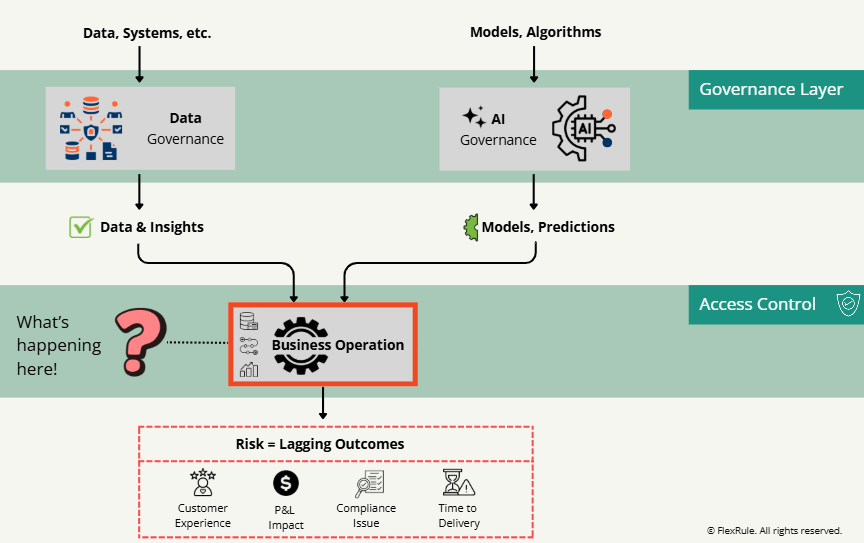
Organizations govern data and AI and processes, but their outcomes are lagging from various metrics.
Each domain governs a part of the system. None governs the decision as a whole. This leads to a structural gap. Controls are applied at different points, but they are not connected. Context is lost between stages. Authorization is often static, based on predefined roles rather than real-time conditions. Execution is triggered by systems without a clear understanding of whether the action is appropriate in the current situation.
The result is predictable: governance breaks down exactly where it is needed most, at the moment a decision is executed an action is taken.
Decision Governance as the Missing Layer
To operationalize AI effectively, organizations must shift their focus from components to decisions. A decision is not a rule, a model, or a workflow step. It is the point at which information, logic, and context converge to determine an action. For a decision to be effective, it must be understood as a complete cycle rather than a single event. This cycle involves observing relevant data, interpreting that data within context, evaluating possible actions through logic and models, and executing an action.
These stages are often implemented across different systems and teams, but they are rarely treated as a unified construct. When they are separated, the integrity of the decision is lost. Execution becomes detached from context, and governance becomes fragmented. The Decision-Centric Approach brings these stages together into a coherent structure. It treats the decision as the unit of coherence for governance, rather than the individual components that contribute to it.
Therefore, the decision governance works across
- Decision
- Decision Model
- Decision Cycle
- Decision Continuum
The coherence between them ensures nothing falls into crack and outcomes are controlled and aligned.
Governing the Decision Cycle
Decision governance discipline ensures decisions are defined, executed, and controlled as a complete cycle. At the design level, it requires that decisions are explicitly modeled. This includes defining their purpose, the context in which they operate, the logic they use, and the outcomes they are intended to influence. Without this clarity, decisions remain implicit and unmanageable.
At the engineering level, it ensures that decisions are implemented consistently. Data, models, and logic are integrated into a unified decision model, rather than scattered across code, prompts, and workflows. This enables traceability, reuse, and controlled evolution. At the operational level, it governs execution. Actions are not triggered simply because a system allows them. They are evaluated within the context of the decision. This introduces the concept of admissibility: an action is only executed if it is valid within the current situation and aligned with the decision intent.
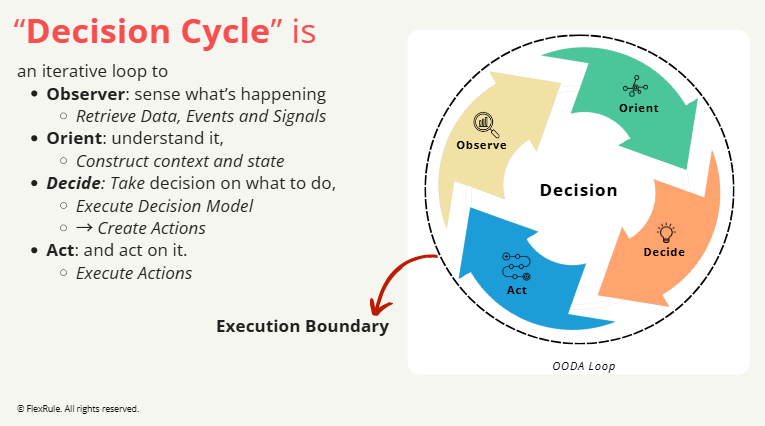
Decision-cycle defines what the execution boundary is, for both decision and actions execution.
This is a critical shift. Traditional authorization models determine who can act. Decision governance determines whether the action itself is appropriate. The boundary of execution is no longer defined by access control or system capabilities; it is defined by the decision cycle.
From Isolated Decisions to a Continuum
In practice, decisions do not occur in isolation. Each decision cycle influences the context of subsequent decisions. Actions taken at one point in time shape the data, constraints, and opportunities available later. Operationalizing AI therefore requires not only governing individual decisions but also managing the relationships between them that each cycle may happen over time.
This leads to the concept of a decision continuum. Decisions are connected over time where in this continuum of decision-making, multiple actors make decisions, and execute actions and influence downstream customer touch points in a journey, operational flows, and strategic processes. Within this continuum, organizations must manage state, monitor changes in context, detect drift in behavior or performance, and adapt accordingly.

A decision-cycle in continuum understands the upstream influences and downstream impacts.
AI plays a critical role here, but again, not in isolation. Models contribute to decisions within this continuum, and their impact must be evaluated in terms of downstream effects, not just local accuracy. AI, humans and systems are just actors making decisions and executing actions over time, where it should be aligned with outcomes in a controlled environment.
Admissible Actions
The missing piece inside almost all of AI Governance is this layer is admissibility. The problem how they approach it is a magical thinking about where those actions coming from.
What actions an agent should be taken in this specific scenario based on this context?
The answer to this question is the admissibility. Guess what? This is a business question, not a product, or authorization layer of any sort.
An endeavor to answer a business question is called “business decision”.
Therefore, a decision model representing the answer will have the data, context, situation and result of executing of the decision model will create the admissible actions. This is the context of decision-centric model solving next best actions problem.
The problem is that organizations collapse authority, authorization, context, and execution into runtime, losing the boundary decision-action. Authority defines what is allowed, including policies, regulations, and business constraints. The decision model is the formal expression of that authority, defining which actions are admissible in a given context for a specific scenario.
An upstream Decision Cycle still answers admissibility related questions. The “Observe” and “Orient” steps of the decision cycle are responsible only for constructing the context and memory. The “Decide” step then applies the decision model to that context to determine which specific actions are admissible. Finally, the “Act” step executes or delegates only those actions that have passed the admissibility filter.

Example of a decision model producing the admissible actions that are optimized and compliant.
Additionally, an authorization level then applies on the actor level to ensure whether or not this specific actor has access to carry out those actions.
This separation is critical. Admissibility does not come from a thin air! It is the result of a decision model execution. Without admissibility decision model, actions are static and guesswork, execution is unconstrained. With admissibility decision model, every action is bounded, explainable, and aligned with intent and you can trace why in these specific circumstances an agent had that action available.
Reuse and Control Through Decision-as-Asset
As organizations scale their decision-making capabilities, reuse and consistency becomes essential. Logic should not be duplicated across systems or reimplemented in different forms. Instead, decision logic, such as rules, models, and computations, should be treated as reusable assets.
More importantly in a multi-actor environment where AI, humans and systems execute a full decision cycle, results of the execution must be consistent and reproduceable across all scenarios done by all actors.
This is where the decisions must be treated as an enterprise asset, not only for exestuation standpoint but also from their maturity too. When we have a decision as an asset, we can make sure they have a right decision frame and progression path they can go through a decision maturity model (From L0 -> L4).
These assets must be governed, versioned, and discoverable. They form the building blocks of decision-making and ensure consistency across the organization. Managing these assets is not a matter of code repositories alone. It requires a structured approach to how decisions are defined, shared, and evolved. This is where the concept of decision asset management becomes relevant: providing a controlled environment for managing the decision, decision cycle, decision continuum, decision model and all related components and artifacts.
Get Your Own Decision Governance Playbook
This playbook enables you to:- Plan Decision Maturity Model for a business function.
- Surface 'Invisible' decisions: Build your first Decision Inventory.
- Strategic Decision Frame: Align operational decisions with business outcomes.
Powered by the Decision-Centric Approach®

What Changes When Decisions Are Governed
When decision governance is applied, the structure of the organization’s operations changes fundamentally. Decisions are no longer hidden within systems; they are explicit and visible. Execution is no longer separate and scattered in code, dashboard, data, scripts, hidden human judgements, AI prompts and AI agents. it is part of a controlled cycle.
This is a shift from:
- From unmanaged and implicit decisions
- → To explicit and governed decisions improving decision effectiveness.
- From decisions being hidden and scattered in code, ai agents and llms.
- → To reusable and executable decision nodules
- From actions happening without control and outside of commit boundary
- → To execution fully bound to the decision cycle… with admissibility, authority and reproducibility
- From risky and unpredictable outcomes
- → To outcomes that are defensible, traceable, and continuously improved and aligned with business objectives
This is what it means to become a Decision-Centric Organization.
Conclusion
Operationalizing AI is often framed as a technical challenge: deploying models, scaling infrastructure, and integrating systems. These are necessary steps, but they do not address the core issue. The challenge is not how to run AI anymore. It is how to ensure that AI, humans and systems contribute to the overall goal of organizations in a meaningful and measurable manner.
We cannot govern outcomes. But we can control and align them with business objectives, culture, organizations goals and values by shifting in perspective and focal point to decisions. The enables organizations to gain control over outcomes. And in the end, that is what operationalization is meant to achieve.
Read More
Last updated July 31st, 2026 at 11:21 am Published April 1st, 2026 at 12:45 pm