Decision governance is often discussed, but rarely operationalized. To operationalize it we need to understand the decision governance pillars and how they preserve the integrity of business decisions over time. This ensures the strategic outcomes of each pillar and quality of decisions assessment is established across teams.
In many organizations, the term governance has been reduced to static frameworks, review meetings, or the after-the-fact analysis of data, logs and traces. While these activities may provide insight, they do not constitute governance.
Decision governance is not about reconstructing decisions after they happen nor it's about guessing and speculating based on data, logs and traces.
Decision governance leads decisions with intent which is based on clarity, transparency and accountability. To be effective, governance must be built on a clear structure consisting of three foundational pillars. If any one of them is missing, decision governance cannot exist in practice.
Decision Governance in Practice
It is a mistake to view the three pillars of decision governance as phases in a lifecycle. They do not start and end in a linear order. They are also not tied to a specific environment (e.g. development, production, etc.). Instead, they are structural and interdependent:
- Decision Design Governance defines intent and influences how decisions are built and executed
- Decision Engineering Governance governs the technical implementation required to support decision intent
- Decision Ops Governance compose value-driven decisions, feeds real-world behavior and outcomes back into engineering or design
Together, they form a continuous practice that governs decisions from definition through execution and over time.
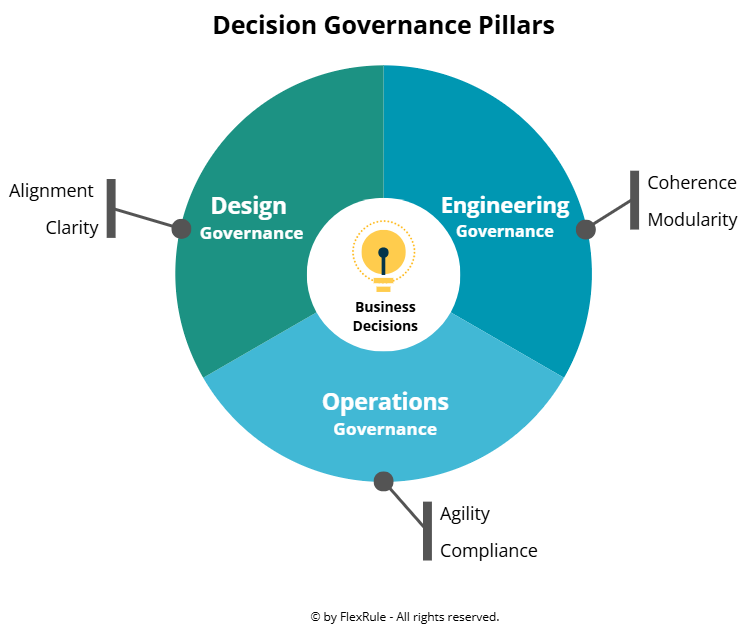
Decision governance in practice ensures the decisions made and executed in organizations are ethical, transparent, repeatable, and outcome-aligned.
The foundational pillars should be embedded into teams' workflows from the beginning. This ensures governance does not become afterthoughts and be reduced to logs and traces investigation.
Book a Custom Demo
Design Governance Pillars
The purpose of the decision governance pillars is to preserve the integrity of business decisions, ensuring they serve their intended purpose, create business value, remain aligned with business objectives, and maintain decision quality over time without compromising the business agility required to operate in dynamic, changing, and regulated environments.
Decision Design
Decision Design governs why a decision is important and how the decision is defined, structured, and changed.
Defining decisions and their frames is a critical path to decision governance; it clarifies why an organization should care about a decision, what the decision is, and how the organization goes about making it.
It answers the fundamental questions of intent:
- What is the decision?
- Why should you care about it?
- How does the decision align with organizational goals?
- What inputs does it use?
- What logic determines the outcome?
- Who owns the decision?
- Who is allowed to change it?
- When should the decision be activated?
- Who reviews outcomes in the loop, and when?
Bridging the Boardroom Gap
The gap between what happens in the boardroom and what senior executives and management decide to operationalize is always massive. Strategic decisions should not sit in meeting notes and reports; they are cornerstones of governance.
Decision Frames fill that gap by specifying strategic decisions and their initiatives. They specify why a decision matters and how it contributes to business value directionally at any point in time. Based on these frames, a series of Decision Models are defined to realize those business values.
Explicit Modeling
When decisions are implicit and are scattered across code, buried in dashboards, or hidden in documents and processes the governance becomes impossible.
Decision models make decisions explicitly defined based on the business decisions. This is the core activity of the Design pillar. It enables teams to clearly understand the full picture of the decisions. Furthermore, when done properly with the right notation and language, it creates a specification that enables execution right out-of-the-box.
Designing for the Continuum
Decisions do not exist in a vacuum. Therefore, Design Governance must account for the Continuum of Decision-Making.
The design must specify the Activation Scenario for each model. That is defining the circumstances under which it should be triggered and how its outcome should influence other decisions. The design process blueprints how decisions fit into a larger ecosystem when they are activated in a continuum and how they influence each other directly or based on collected feedback.
The goal of Design is to map this continuum to ensure that when the system runs, it aligns with strategic KPIs and impact. Design influences everything. It is the role of governance to put that design in place.
Design governance relies on explicit Decision Frames, Decision Models, and a clear map of the decision continuum. Therefore, decisions become visible, versioned, reviewable, and owned. Without an explicit design, there is no governance, only assumption and gut feeling.
Strategic outcomes
This pilar has two strategic outcomes:
- Alignment: Ensures strategic, operational, and lifecycle decisions are consistently aligned with business goals and intended outcomes.
- Clarity: Makes decisions explicit, understandable, and owned by clearly defining what the decision is, why it matters, how it works, and when it applies.
Engineering Governance
Engineering governance governs how business decisions are translated into executable, reliable, and controlled decision artifacts.
It focuses on the faithful realization of decision design, ensuring that what is implemented matches the intent, structure, and constraints defined under Design Governance.
Engineering governance answers the fundamental questions of realization:
- How is the decision implemented in executable form?
- How do we ensure the implementation matches the decision design?
- How are versions built, packaged, and validated?
- What technical controls ensure correctness, consistency, and safety?
- Who is responsible for implementing and releasing changes?
- What does the integration (data, service, system) look like?
- Where and how are inputs sourced?
- How are feedback signals captured and fed back?
Decision Engineering governance acts as the enabler between Decision Design and Decision Ops. It equips DecisionOps to build, deploy, monitor, and measure decisions independently. Decision Engineering pillar provides the backbones (infrastructure, shared libraries, decision-ready data, etc.) required by DecisionOps, so decisions can be built by the functional teams that operate closest to the business.
It ensures that decisions are engineered in a way that is testable, repeatable, auditable, and ready to run, while preserving traceability back to the original decision design.
Without engineering governance, decisions drift between design and reality. What is defined is not what is built, and governance breaks at the point of implementation.
Strategic Outcomes
There are two strategic outcomes for this pillar to ensure governance without owning real-world business scenario, execution or outcomes.
- Coherence: Transparent and aligned components that fit together for the purpose of the intent.
- Modularity: Independent, composable building blocks that downstream teams can assemble, change, and evolve without breaking Design governance.
Operations Governance
Operations governance governs how business decisions are executed, observed, measured, and scaled in real environments.
In Operations governance, the execution does not imply digital, or automated decisions. It simply means an actor (i.e. human, robot, AI) carries out a decision in an environment that is live. Although, when decisions are automated and executed using machines, provides significant advantages over a manual execution.
Most decisions do not fail abruptly. They fail gradually. Performance erodes, assumptions change, and risks accumulate silently.
Operations governance concerns about the following areas:
- Compose decision logic based on policies
- Assemble business scenario using decision modules
- Operationalize them by safely rolling out and scaling decision changes to real users (adaptive control)
- Monitoring outcomes and key performance indicators (KPIs)
- Understanding decision impact and side effects
- Detecting drift, bias, or degradation
- Managing exceptions and operational incidents
In Operations governance the executing decisions in the right time with the right context in real environments happens in this pilar.
The DecisionOps team are responsible to compose decisions and assemble business scenarios. They are people close to the operation and domain, they understand the domain have the knowledge and experience, so they know the logic, policy, reasoning behind the decisions.
DecisionOps team is holds the core responsibility of the Operations governance where tire hits the road.
Strategic Outcomes
There are two outcomes for this pillar that ensures decisions remain aligned with business intent over time, rather than slowly drifting into non-compliance or inefficiency.
- Agility: Enables decisions to be executed, adapted, and evolved quickly in response to changing situations, contexts, and feedback without breaking governance.
- Compliance: Ensures decisions are executed within defined policies, controls, and constraints, with traceability, auditability, and accountability at runtime.
Agility without compliance is chaos and compliance without agility is paralysis.
Business Decision Quality
When it comes to business decision, the quality of them is not opinion, it is a measurement of their effectiveness. Therefore, its pre-determined quality is a proxy to ensuring the far-reaching impact of the decision lands the way business envisions.
Hence the Decision Governance Pillars exist to preserve that quality of decisions over time, we need to have a way to assess this quality.
Quick ACT™ Framework
Quick ACT™ defines what “good” looks like for a decision. The Quick ACT™ framework formalizes how decision quality is assessed.
A high-quality decision must be:
- Accurate
Zero tolerance for approximate logic or incorrect reasoning. - Consistent
Identical behavior across environments, channels, and executions. - Transparent
No black boxes. If a decision cannot be explained, it cannot be governed. - Quick
No delay in acting or adapting. Decision value decays over time.
ACT refers to Action.
A decision that is not acted upon does not change behavior and therefore creates no value.
Now you can map “Quick ACT™” explicitly to Design, Engineering, Operations Governance provides an explicit quality metrics and guardrail on how “good” should be measured.
Final Thoughts
Decision governance is not a philosophical exercise. It is an operational discipline.
| Pillar | Without Governance | Result |
|---|---|---|
| Design | Decisions are invisible | Assumption |
| Execution | Decisions are uncontrolled | Liability |
| Operational | Decisions decay | Drift |
Frameworks do not govern decisions.
Operationalized governance does.
That is the difference between talking about decision governance and actually having it.
Read More
Last updated March 20th, 2026 at 11:59 am Published February 2nd, 2026 at 10:44 am