Learn about decision modeling alternative to avoid Decision Doodling and Start Decision Modeling! Illustrations and doodling of decisions have some value, but they are not the same as Decision Modeling.
Business decisions are the critical part of business operations. They are not processes, rules, machine learning algorithms, or pipelines to knowledge graphs. They are very self-existent entities in organizations that should not be overlooked and become afterthoughts.
This means you have to start modeling them explicitly. If you do not use a proper modeling technique, you will lose information, and it will become very hard to improve, refactor, and automate them down the track. But the question is, what are the right modeling techniques that will not hold you back?
In this post, we are going to explore multiple alternatives in decision modeling.
Causal Decision Diagram (CDD)
This type of decision model is a flavor of influence diagram that allows you to depict the relationship of nodes based on their cause and effect. It intends to model the decision to outcomes using a couple of node types.
The main benefit of this technique is that it uses a visual technique that enables the understanding of decisions at a very high level based on outcomes, levers, external influences, and a series of intermediate nodes. They are all connected via the dependency chain from levers (inputs) to the outcomes.
Hence, this technique is very easy and leverages a visual diagram; it is understandable by a wide range of stakeholders and decision-makers. It opens the opportunity for whiteboard sessions to understand and analyze the elements influencing a decision's outcome.

The above example illustrates how a profit of a product is influenced using a simulation.
CDD is more of an analysis technique and eliminates the need of remembering everything about a decision and captures them based on the influences they have on each other as well as the feedback relationship and external influences.
In theory, this enables teams of stakeholders and data scientists to unfold what they are trying to solve by establishing a high-level big picture of the causal-and-effect relationship between decision components. CDDs tend to be informal and focus on illustrating the big-picture causal flow.
Think of CDDs as “decision doodling” that they embrace a free-form, visual technique to map out decision factors and their causal relationships. They are a good visual tool for early-stage analysis and brainstorming sessions.
Let's have a look at its overall applicability and pros and cons
Pros:
- Visual diagramming techniques
- Clarity about how the decision is made at a very abstract and very high-level
- Understandable with non-technical stakeholders
Cons:
- Requires hand-over for development of models to automate
- No special focus on the next level of decision logic
- No language to express runtime behavior
- CDD is an imperfect visual of the decision rather than a detailed specification
- They are not executable artifact and act only as a high-level and rough analysis artifact
Decision Model and Notation (DMN)
This is an open standard comprised of multiple modeling techniques that enables teams to model business decisions precisely, automate and execute them from a top-down approach using multiple different types of decision logic making it an effective decision modeling alternative. The decision models created by DMN are the live specification of the business decisions, not just a visual doodling tool.
DMN starts modeling decisions with a visual diagram called Decision Requirements Diagram or DRD. This model defines how decisions are made at the conceptual level. It specifies the “how” in a visual diagram and uses the decomposition technique to breakdown a complex decision into smaller, more easy-to-understand subcomponents.

Above is an example of DRD which as shown it allows you to understand the dependencies, influences, flows and it can highlight upstream and downstream subcomponents for further clarification.
One of the geniuses of DRD, created by Alan Fish, is that you can look at the DRD model in a cause-and-effect relationship, decomposition, dependencies, and decision flow. Depending on the audience and the problem you are solving, you can view and interpret the same DRD model from multiple angles and viewpoints.
Overall, the value of DMN is massive for organizations to practice decision management and modeling:
- Help stakeholders grasp complex decision-making domains through clear, easy-to-read diagrams.
- Provide a solid foundation for discussions and agreements on the scope and nature of business decisions.
- Reduce effort and mitigate risk in decision automation projects by decomposing requirements of complex business decisions.
- Allow business rules to be clearly and reliably defined in straightforward decision tables.
- Enable the development of reusable decision-making libraries and components.
- Simplify the development of business rules and decisions in IT systems and processes with specifications that can be automatically validated and executed.
- Ensures successful integration of advanced analytics, machine learning and, predictive analytics, and AI models in decision-making scenarios
The key to explainability, clarity and transparency of business decisions is the Decision Model and Notation (DMN) with Conformance Level 3 which is part of our Open Decision Intelligence Platform.
To summarize the DRD approach from DMN:
Pros:
- Progression path from doodling to fully executable and automated decisions
- Covers conceptual visual model top-down approach
- Allows modeling multiple decision logic
- Enables integration with data and analytics, predictive models, and scorecards
- Out-of-the-box supports modeling business rules visually (simple and complex rules)
- Out-of-the-box provides expression language (similar but better to Excel formulas) named FEEL
- Extensible to enable other types of decision logic
Cons:
- Supports only stateless decisions
- Static model that is not dynamic or adaptive but flexible and well-structured to change and manage easily.
- Multiple conformance levels can dumb it down to a just doodling tool with no execution and automation ability.
Book a Custom Demo
Dynamic Decision Graph
This decision model as part of our platform extends the Decision Requirements Diagram (DRD). It addresses the lack of adaptive and dynamic behavior in DRDs. A Decision Requirement Diagram very well structures and specifies how a decision is made which makes a great decision modeling alternative. Each node on the decision graph is responsible for a specific decision logic of some sort (rules, expressions, predictive model, etc.). However, those decision nodes will always be executed and have a fixed decision logic linked at design time.
In contrast, we created something called the Dynamic Decision Graph which is a way to make DRD dynamic and adaptive.
The nodes of a Dynamic Decision Graph have entry conditions. Decision logic can be determined at runtime, or execution can be skipped under certain circumstances. Additionally, before and after every node execution, you can conditionally trigger other behaviors, such as loading specific data.
The best part is that it has all the benefits of DRD in terms of approach and outcome. It is also dynamic and adaptive and supports situation-aware decisions in a regulated, dynamic, and changing environment.
To summarize our proprietary technique “Dynamic Decision Graph” based on DRD:
Pros:
- Everything that DRD has ➕ below
- Dynamic and adaptive to its environment
- Not required to load data upfront from outside and pass it in
- Can skip node execution and resolve the logic at runtime
- Allows nested logic (link other decision logic such as flow, other DRDs and Dynamic Decision Graphs etc.)
- Enables real-time decisioning supporting both probabilistic and deterministic decisions
- Supports for all stateless, stateful and long-running decisions
Cons:
- Too much nesting logic makes modeling complex. Balancing levels of nesting is essential.
Brochure
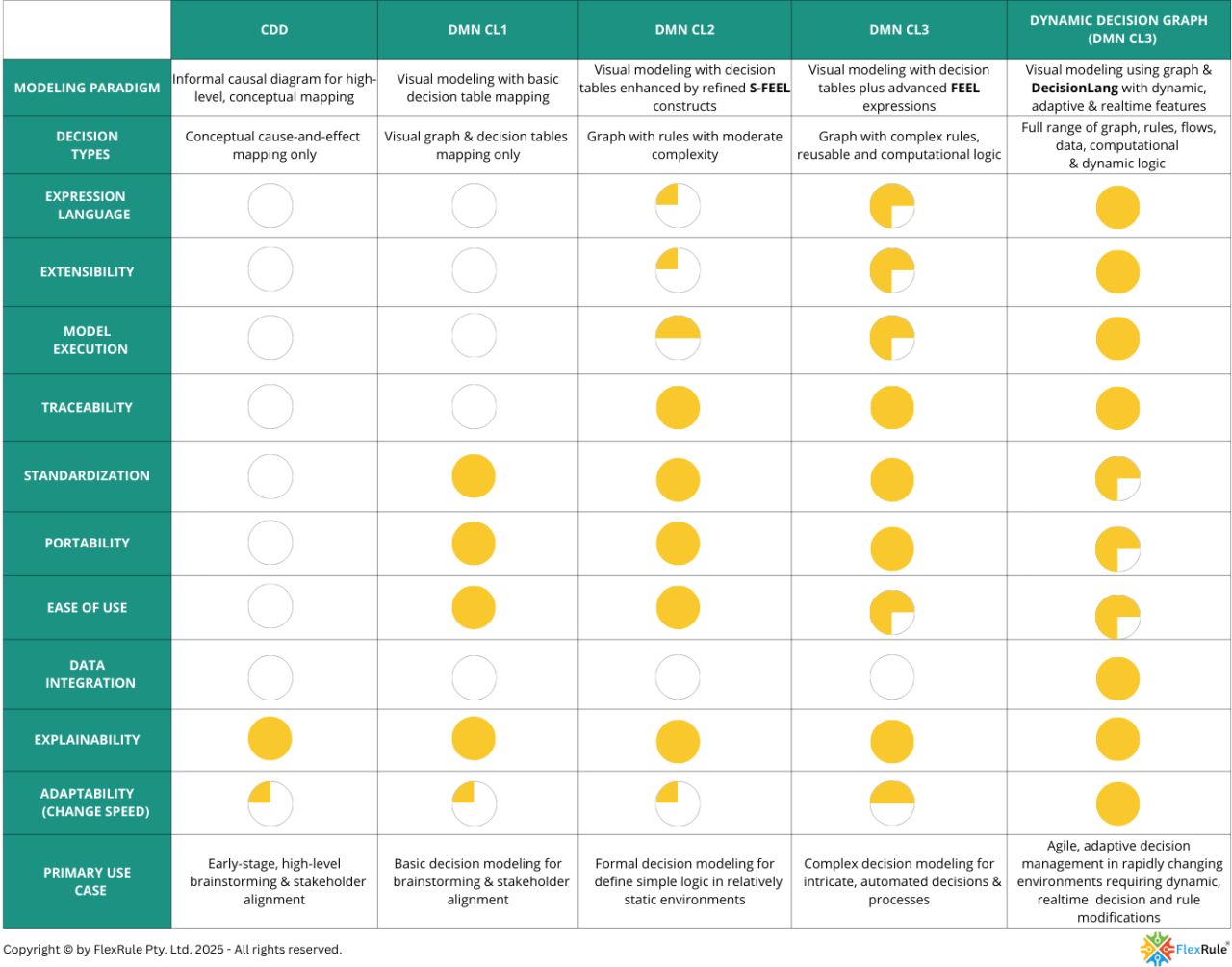
Decision Modeling Techniques Comparisons
From Doodling, to Open Standards and advanced proprietary models to adaptive and realtime decisions.
Summary of Decision Modeling Alternative
Any “Decision Doodling” is good for brainstorming and ideation, but proper decision modeling is what enterprise needs. Therefore, any Decision Doodling does not make a good choice for a decision modeling alternative. Having said that, if you are looking for a tool in ideation stage, the Decision Requirements Diagram (DRD) can also drive a decision ideation effectively. The good thing about DRD is you can get as details as you want, and if you use DRD as the base for ideation and brainstorming, you are one step ahead, by adding more details it is the actual decision artifact that you can execute.
Last updated November 3rd, 2025 at 11:23 am Published March 27th, 2025 at 11:34 am