Continuous improvement is about ensuring that your decision logic i.e. business rules, and strategies evolve over time instead of becoming stale. You need to continuously and dynamically create new rules or update existing rules for the specific decisions. This is to ensure that new situations are continuously included as part of the decision logic.
Your business rules to today's state of the case might be valid, but when the state of the case changes, your decisions based on the previous rules may be stale, and you will need to learn more about the new state and new business rules related to the new state of the case. But how can you understand the rules from the new state of the case?
Generally, business rules are modeled by domain experts and operations teams in decision automation scenarios. But what if you see a behavior in your operational system from your customers, clients, etc. but you don't know the business rules? This is where the need for business rule mining arises to extract, analyze, and understand business rules from customer or market data
Business rule mining is the ability of a system allowing you to extract rules from data. In this process, you connect the data FlexRule Designer and it will analyze the data and extract the rules from it.

The overall process of business rule mining for continuous improvement.
The business rule mining enables business analysts, or operation people take the historical data from operational database and systems, provide them to the business rule mining module and FlexRule Designer processes the data, automatically apply multiple different Machine Learning algorithms, and represents a readable form of rules such as below:
if (Outlook == 'sunny') and (Humidity <= 70) then Play = 'yes'
 if (Outlook == 'sunny') and (Humidity > 70) then Play = 'no'
 if (Outlook == 'overcast') then Play = 'yes'
 if (Outlook == 'rain') and (Windy == false) then Play = 'yes'
 if (Outlook == 'rain') and (Windy == true) then Play = 'no'
Ready to Use – Simulate, Debug, Deploy and Explain
FlexRule Designer will take it one step further and prepare and model a Decision Table and Fact Concept related to those rules automatically and will add them to the project.


Now you can start debugging and simulation activities, play with the rules by feeding relevant values for inputs (conditions), and retrieve the results (outputs):

As you see in the below screenshots, after rules execution is completed, the result is set to “Yes”.

One of the benefits of this approach is because the decision is now driven by rules rather than a particular Machine Learning trained model, you have the full visibility and explainability on why a specific decision is made:

Continuous Improvement
The kind of business decision where a continuous change of state of a case over time does not allow the final decision outcome to be conclusively determined in a single cycle/iteration of decision execution is called continuous improvement.
Depending on the frequency of the change of the case's state, there are different approaches that can be utilized to implement continuous improvement scenarios:
- A long-running decision allows the state changes to be tracked and responded to over a span of time in multiple connected execution sessions.
- Decision Graph's state management ability can handle how to respond to the new changes of the case within itself rather than an extra process management or other code-driven approach.
- Integrated Rule Mining and CICD to extract new knowledge from cases and situations and create new decisions for the future
Where the frequency of the change is not (nearly) real-time – business rules mining gives you the ability to update the decision based on newly discovered rules for the future state of the case.
Business rule mining is a very important part of the continuous improvement process. The business rule mining module enables you to utilize a Machine Learning with a couple of clicks without having the knowledge of a data scientist and extract the business rules from your data.
Book a Custom Demo
What is Rule Mining?
The rule mining is the analytical side that powers continuous improvement. It uses data-driven techniques to:
- Discover hidden patterns in historical data (e.g., association rules, decision trees).
- Extract candidate business rules from operational data, logs, or transactions.
- Highlight underperforming rules by comparing expected vs. actual outcomes.
- Suggest optimizations (e.g., replacing thresholds, merging conditions, or identifying redundant rules).
Rule mining bridges analytics and knowledge engineering: instead of starting rules from scratch, you can refine or generate them automatically from data.
One of the challenges of static pre-defined business rules is that they are disconnect from environment and user preferences and their interactions. With the automated business rules mining using Machine Learning techniques you can build a fully automated continuous improvement scenarios that integrates new scenarios back into the overall model.
There are various Machine Learning models that allows you to build either a fully transparent rules model from new data points, or a ML trained model as part of refresh batches of the data received from user interactions.
In this article we used a C4.5 to extract rules from the data (operational, user's behavioral data, etc.) but you can also train different models with a wide range of available algorithms as part of the AutoML platform or selective individual algorithm of your choice.
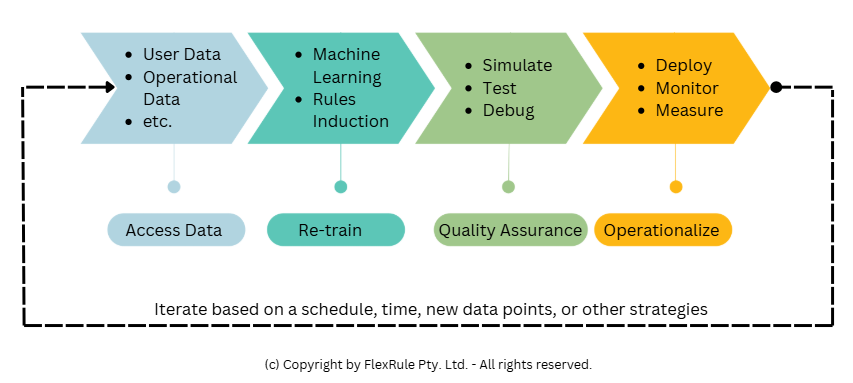
By building above process into any continuous integration (such as a CICD pipeline, or any custom process to refresh models based on schedule or data points) you can deliver a continuous improvement by looking at the latest dataset in systems, user's behavioral data points, operational databases and etc. and create an automated process that re-trains existing rules on new data and puts new and updated rules into decision models.
With this approach, you can keep monitoring and measuring the Decisions KPI constantly and improve them as needed in an iterative and incremental manner.
Last updated February 9th, 2026 at 04:07 pm Published September 3rd, 2020 at 11:10 am